Lumber Camp Cook

Rita Poirier Chaisson was born in 1914 on Canada’s Gaspe Penninsula. In 1924, her father Paul Poirier, a lumberjack, moved the family to the North Country where logging jobs were more abundant. Her mother agreed to leave Canada with reluctance. The Poirier family spoke French, no English, and she was convinced that New Yorkers “just talk Indian over there.”

The family kept a farm near Tupper Lake, with as many as 85 cows. Rita planted potatoes and turnips and helped with the haying. She and her siblings attended a local school, where she was two years older than most of her classmates. Although she picked up English quickly, her French accent made integration difficult. She left school at the age of 14, and worked as a live-in maid, cooking and cleaning for local families for three dollars a week. She used her earnings to purchase clothes by mail order for her sisters, mother, and herself.

At 17, Rita married a lumberjack with whom she had five children. The family moved to New Hampshire for a brief period, but Rita left “because the kids didn’t like it.” The marriage fell apart, and Rita raised her children in Tupper Lake as a single mother.

To make ends meet, she took work as a cook in lumber camps, moving around from camp to camp. In summer, she cooked for men cutting softwood and at another camp in winter where the men harvested hardwood. Working May through February, she was forced to rely on unemployment benefits to get by in March and April. Her children stayed in town while she was in camp during the week, cared for by friends and family, spending summers with their mother and the jacks in the woods.

As the only woman for miles, Rita preferred working in camps with separate buildings for the kitchen and sleeping quarters. Although she always had her own room, if the men were in the same building the odor of unwashed clothes and bodies permeated everything. Some of the men chose not to walk to the outhouse when it was cold at night, instead of using a designated spot at one end of their bunkhouse.

Smells aside, Rita was always on good terms with the men, and the jobber always made sure that she had no problems. At Christmas, each man gave her a dollar. Only once was she propositioned, by a young man who asked “Hey cook, you wanna go out tonight?” Rita responded that “if I’m gonna go out, I’m gonna go out with a man, I’m not gonna go with a kid.”

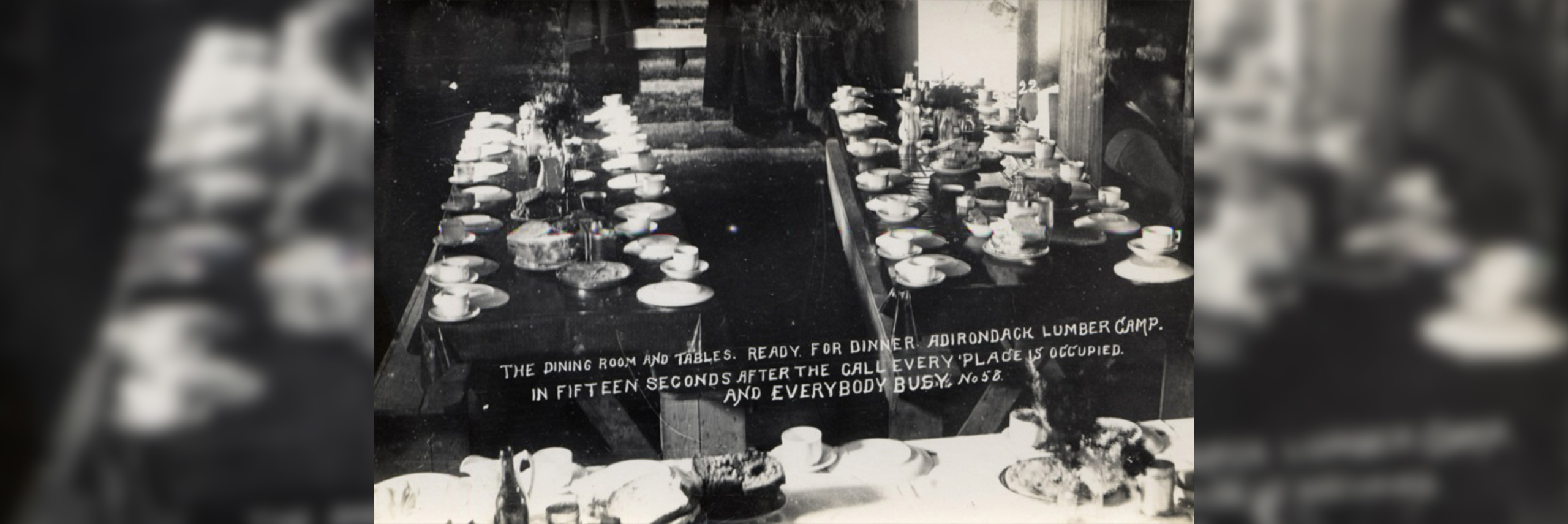
Rita worked for smaller outfits because she didn’t want to cook for more than 35 men at a time. As it was, she maintained an impressive schedule: up at 4 am, serving breakfast at 6, usually with bacon and fried potatoes, pancakes, toast, and fruit. She served lunch at 11:30. If the men were staying out all day, she’d pack them lunches. The last meal of the day, at 5:30, usually included steak, roast beef or pork, cabbage, and bread. Cooking in-between meals, Rita often made 7 pies, 2 batches of cookies, 2 cakes, and as many as 500 doughnuts and 8 loaves of bread each day. She never went to bed before 8 or 8:30.

Adirondack lumberjacks earned their pay- it was heavy physical labor. As a camp cook, Rita was responsible for filling their plates well. She recalled that “they worked hard and the weather was cold so I always made sure they had good meals… of course, I had to plan everything ahead to make sure I had time to cook everything. We only had wood stoves then, you know.”

Meals were eaten in silence. A sign in French and English was posted at the entrance of the dining hall indicating that no talking was permitted. The men were hungry, and ate as though “they were starved to death!” During meals, Rita made sure that each lumberjack had enough of everything, walking between the long tables with a fresh pot of coffee and placing condiments at regular intervals along the tables.

Rita worked for the most part without written recipes. She collected a few by cutting them from the backs of macaroni and raisin boxes. She made macaroni salad with instant and evaporated milk, and “the men went wild with that.” Another popular dish was one she composed of homefries and hot dogs ground together and fried in pure lard. Cauliflower “with a nice milk gravy” was “out of this world.”

Working long days in isolated camps miles back in the Adirondack woods, Rita had little time to form friendships but “I never had time to be lonely.” There were other compensations: “Oh, the smell of the pine. And the air was so fresh. You’d wake up in the morning… oh, my God, you felt like a millionaire.”

Rita retired from camp cooking after 20 years. She worked into her eighties, taking in laundry and selling second-hand clothing from her home. In the late 1980s, she spoke to a reporter saying, “Those 20 years in the woods were some of the best in my life. The only problem I’ve had since retiring is trying to break the habit of cooking for an army.”

In 1996, a folklorist interviewed Rita Chiasson about her life. The tape and a typed transcript are in the collection of the Adirondack Museum in Blue Mountain Lake.
Corn

In 1916, the New York Commissioner of Agriculture reported that Essex County is “by far the most broken and mountainous section of the state.” In spite of the fact that only about one-third of the area of the county is in farms and only about one-eighth improved farms, there is a remarkably good report of agricultural production. County farmers produced 96,383 bushels of corn in 1915, along with barley, oats, buckwheat, potatoes, and hay and forage.

Corn has long been a staple food in the Americas. It is a domesticated plant, bred from a wild grass native to southern Mexico nearly 7,000 years ago. Its use as a cultivated food plant in the northeastern United States began about 1,000 years ago.

Although the Adirondack climate is not generally conducive to agriculture, there are pockets in the valleys and surrounding areas where the growing season is long enough, and the soil rich enough, to grow corn. The vegetable was one of the staples of the Haudenosaunee (Iroquois) diet. European settlers in the region grew corn where they could, not only to feed themselves but to feed their livestock as well. As settlement and tourism in the region grew, Adirondack hotels and resorts kept kitchen gardens to feed guests. Adirondack families grew their own vegetables, preserving what they did not eat in season for the long winter months. Locally grown corn was featured on the menu for human and animal consumption.

Although the Commissioner’s 1916 report indicating that most crops grown in Essex County were produced “for the supply of camps, cottages, hotels, and summer tourists,” by the late 1800s, some northern New York farms were growing enough corn to export to wholesale dealers in cities like Boston, Syracuse, Rochester, Watertown, and New York City.

During the Depression, newspapers like the Malone Farmer offered advice on creating healthy and inexpensive meals. In October 1931, readers were advised that “as for cost, corn preparations are among the more economical of the common foods. Two pounds for five cents is the average price per pound by bulk for both cornmeal and hominy.”

A regular column, called the “Market Basket,” offered readers tips on shopping, canning, cooking, and sample menus. The May 20th, 1931 edition also included a recipe for corn soup:

• 2 cups canned crushed corn
• 1 cup water
• 1-quart milk
• 1 onion, cut in halves
• 1 tablespoon flour
• 4 tablespoons butter
• Salt to taste
• Pepper

Combine the corn and the water, cook for 10 minutes, and stir constantly to keep from sticking to the pan. Press the corn through a strainer. Heat the milk and the onion in the double boiler and thicken with the flour and fat, which have been well blended. Add the corn pulp, salt, and pepper, Heat, remove the onion, and serve. Buttered popcorn makes an interesting substitute for croutons to serve with corn soup.

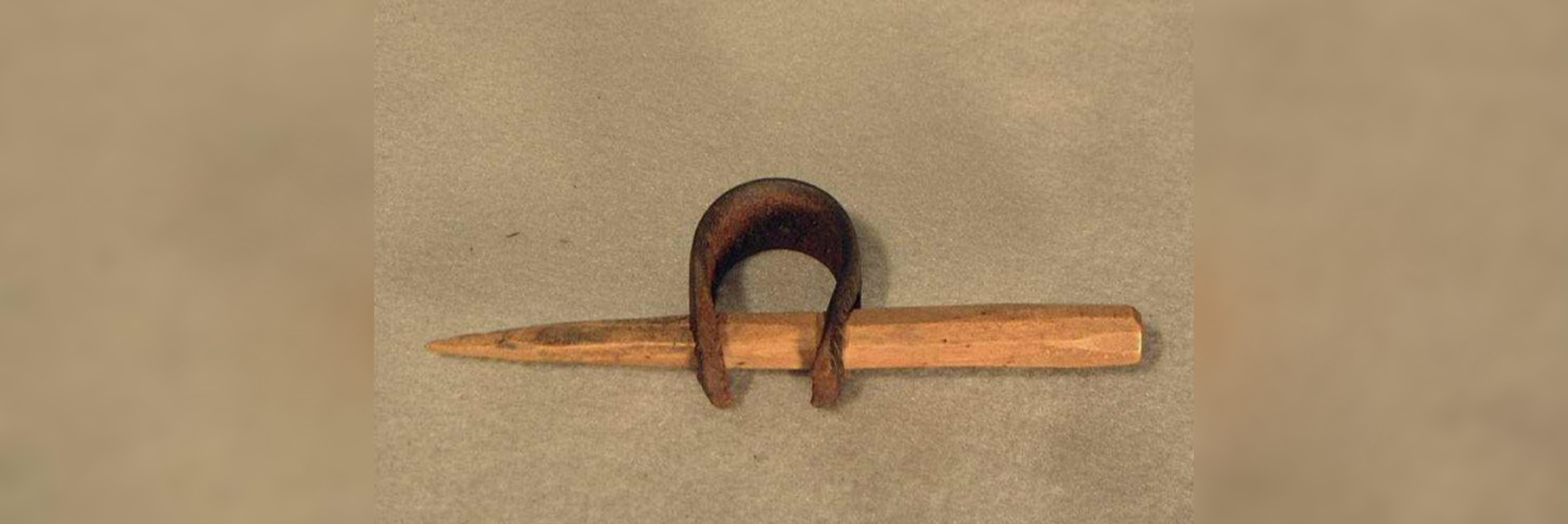
Adirondack farmers hosted “husking bees” during harvest. Families and neighbors gathered together to remove cornhusks before cooking for a crowd. In Willsboro, an unidentified farmer or family member used a small wooden peg, pointed on one end and held with a strap of leather to the thumb as an aid in removing husks from many ears of corn. Made by hand near the turn of the 20th century, it would have made such a repetitive task easier.

An Adirondack Cast Iron Cookstove

To My Old Cookstove

Oh! My old kitchen cookstove, to time now surrendered,
How well I remember the day you were new.
As so proud in your newness, you stood in my kitchen
So black and so shiny, and fair to my view.
How oft, by your side, in the years that have vanished
I have held my firstborn to your genial heat
And the years in their passing, added still others
‘Till your hearth was surrounded with dear little feet…

Lucelia Mills Clark, a farm wife from Cranberry Lake, wrote this ode to her cast iron cook stove in 1899. Her verse reflects the iconic status of the 19th-century cook stove in the American imagination as the heart of the home, a place where families gathered and generations spent time together when life was simpler.

Although we (and Lucelia) romanticize iron cookstoves as a focus for family gatherings, not everyone was equally enamored of them when they were introduced. Beginning in the 1840s, critics characterized them as poor substitutes for the family hearth. The beauty of a log on the fire was lost, hidden away in an iron firebox, and the pleasure of gathering around to spend time with family was diminished. Iron stoves were also thought to exude dangerous gasses into the air and into food. The heat they generated could be overwhelming, and a source of headaches and stupor. Large and heavy, they could also be unstable, collapsing onto the floor while in use, sending hot ash, fire, and boiling liquids onto floors, walls, and unlucky bystanders.

In spite of these early reservations and limitations, the first iron cookstoves came into common use in the United States in the early 19th century. They used less fuel and generated less smoke than did cooking over a fire. To appeal to potential buyers, however, many early models mimicked fireplace cooking. They were low to the ground and designed so that the fire inside was visible, mimicking a traditional hearth.

As stoves became more popular, manufacturers developed new designs to cater to consumer needs. Low height prevented strain in lifting heavy iron pots. Bilevel stoves allowed cooks to boil on a lower level and use the oven on eye level to reduce unnecessary stooping. Baking compartments became larger, and many models included a water reservoir, which would keep hot water at hand for cleaning and bathing. Stoves also allowed cooks to prepare several kinds of foods at once, a near impossibility on an open fire.

By the end of the 19th century, cookstoves were beginning to look more and more alike in terms of their utilitarian features. Although ease of use and fuel economy were still major considerations for consumers, the decorative value of the stove became an important selling point.

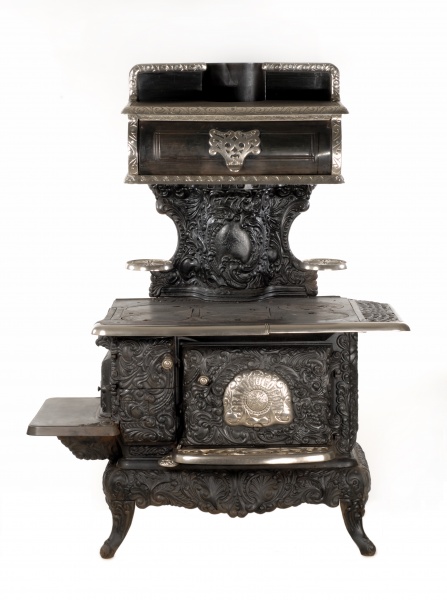
The Adirondack Museum’s “Grand Gold Coin” model, manufactured by Bussey and McLeod in Troy, New York after the turn of the 20th century, features elaborate scrollwork with leaves and basketweave motifs accented with nickel plate. Ornamentation aside, its six burners, elevated warming oven, and rotating warming grills are typical of most models of its time.

Cooking with a stove like this required practice. Temperature was regulated in part according to the quantity and type of wood burned. Different types of wood burn at different temperatures, and some burn longer than others. Birch made a quick, hot fire, maple and beech created a longer-lasting fire, and oak was used for a slow, hot fire. At night, the fire was banked with ashes and the coals used to start a flame in the morning.

Three or four dampers and grates on the sides and rear of the stove also allowed cooks to control airflow into the firebox to adjust the temperature. The hottest burner was usually center rear. One moved pots around the surface of the cookstove to boil or fry at the right temperature. Although stoves were engineered for mass production, no two operated exactly alike. Idiosyncratic stoves meant each cook needed to learn how to use her particular oven.

Keeping the stove clean and rust-free was time-consuming and unpleasant. Household cooks scraped away debris in the firebox on a regular basis and applied stove polish, a black, waxy substance, each day- a particularly onerous task.

In winter, the cookstove also served to heat the home, and the kitchen was often where the family gathered during cold winter days. Large iron stoves could be much less pleasant in summer when the heat radiating from the cast iron could be overwhelming. Many families moved their stoves in the spring to get them out of the house, a major undertaking as the iron stoves were quite heavy.

By the 1930s and 1940s, many Adirondack families were replacing the old wood or coal-burning cookstove with a gas or electric model. Easier to clean and use, and no longer needed for heating the home, the iron cook stove became a thing of the past.

The Trudeau Sanitorium Diet

In Rules for Recovery from Tuberculosis, published in Saranac Lake, New York, in 1915, Dr. Lawrason Brown stated that “there are no more difficult problems in the treatment of pulmonary tuberculosis than to make some patients gain weight and to help others avoid digestive disturbances.”

Diet was an important part of treatment for tuberculosis, the “white plague.” Highly contagious, tuberculosis (or TB) was one of the most dreaded diseases in the 19th century. Caused by a bacterial infection, TB most commonly affects the lungs, although it may infect other organs as well. Today, a combination of antibiotics, taken for a period of several months, will cure most patients.

The drugs used to treat tuberculosis were developed more than fifty years ago. Before then, thousands came to the Adirondack Mountains seeking a cure in the fresh air, away from the close quarters and heat of urban streets. Doctors prescribed a strict regimen of rest, mild exercise, plenty of fresh air, and healthy, easy-to-digest meals.

Patients were encouraged to spend as much time as possible out of doors. The lungs, it was reasoned, responded well to a regular intake of fresh air. The sleeping porches that characterize the architecture of Saranac Lake were designed to “enable a patient to remain out of doors . . . so much that it has been called the ‘twenty-three-hour treatment.'” Patients often spent most of their days outside on a chair or bed, sleeping on open-air porches at night, well bundled up against the Adirondack cold.

One of the characteristic symptoms of the disease is unexplained weight loss. To boost the patient’s strength and ability to fight the disease, his or her weight was monitored daily, along with the level of appetite and food intake.

Dr. Brown, a leading physician and member of the medical team at the Trudeau Sanitorium in Saranac Lake, wrote, “It is an old adage among patients with tuberculosis that they should eat once for themselves, once for the germs, and once to gain weight . . . not only must three good meals but six glasses of milk and six raw eggs be swallowed every day.”

A suggested schedule for a patient’s day included milk on waking in the morning, followed shortly by breakfast; a light mid-morning meal, dinner from 1:00 to 2:00, followed by supper at 6:00, and another light meal just before bed. Patients were encouraged to eat a small meal one-half hour before and one-half hour after taking exercise.

The house rules for the Trudeau Sanitorium specified that breakfast was served in the dining room between 7:30 and 8:30 each morning, and “NO ONE MAY ENTER AFTER THAT HOUR.” Patients were permitted to invite friends for meals, as long as they registered them at the administration desk at least one hour before the meal was served. Conversation about one’s disease, symptoms, “or any subject relating to illness is discouraged, particularly during meals.”

The rulebook also stipulated “only pasteurized milk should be consumed by patients.” Those wishing to purchase milk to drink between meals were provided with a list of local dairies offering pasteurized milk for sale.

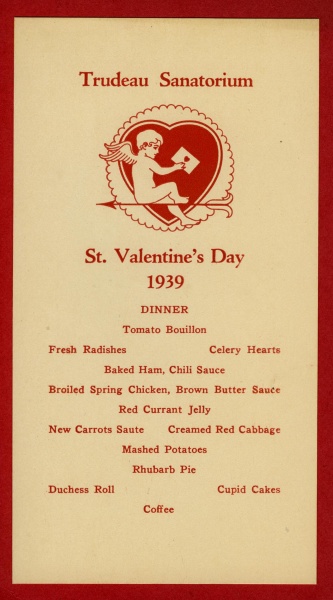
In spite of the regimentation of institutional life, meals were a social occasion, and holiday meals an important part of community life at Trudeau. Christmas, Easter, New Year’s Day, Thanksgiving, St. Patrick’s Day, Washington’s Birthday and Valentine’s Day all featured special menus served with a festive flair.

The New Year’s dinner in 1926 included fried filet of sole with tartar sauce, braised tenderloin of beef with Béarnaise sauce, roast Maryland goose, apple sauce, creamed onions, sweet potatoes glace, endive salad, mince pie, tutti frutti ice cream, assorted cakes, fruit basket, cider, and coffee. Easter dinner, 1921, featured lobster Newburgh, roast lamb, and roast chicken with stuffing. The evening meal on Washington’s Birthday included, of course, cherry pie.

Letters Home Series: Civil War Era Manuscripts from the Collection

The Adirondack Museum Library owns more than 600 linear feet of manuscript material. Included in these vast holdings are the Juliette Baker Rice Kellogg papers. This collection consists largely of correspondence to Juliette Baker (1842-1931); better known as “Julia” to her correspondents. Julia lived in and around Minerva, NY her entire life making this collection of letters an important source of information on the lives and times of early Adirondack settlers.

Julia’s pen pals included many friends and family members that were fighting in the American Civil War. These letters give great insight into the psyche of the soldiers that penned them. Their dreams were simple: to return to the pleasures and normalcy of everyday life. The soldiers that wrote to Julia were looking for news from home in order to escape the drudgery and hardships of life in the camps.

This and the next letter were written to Julia by Cyrus A. Smith. The first is dated January 5, 1865.

Friend Julia
I suppose you will be very much surprised at receiving a letter from this place. But whether you will or not I have commenced I am going to carry it out although without your consent. So you will please excuse me for being so impudent if impudent I am.

But perhaps if you knew who it was or is that is writing you would think nothing of it. I suppose you recollect that 2 years ago a young chap was up in the Boras River hunting grounds and while there was in company with you a number of times. I will not tell my name at present. I was thinking today where I was 2 years ago when the thought struck me that I might write to you if for nothing else but to pass away the spare time that drags so wearily in camp.

Since I last saw you I have seen a great deal of war. I enlisted in a good company I have got along so far alright and hope to get out as well as I am at present. How is Mary Meade and all the rest of the fun loving folks. Also your sister. I have forgotten her name. Well as ever I suppose. Now I have an idea that you would like to know my object of writing so I will tell you it is this. Fun mutual improvement and perhaps something more after I get out of this cruel war business which will be in a short time. Come now Julia drop a line or two to a fellow once in a while to relieve me of the monotony of Camp Life. Hoping to hear from you soon I will close. From a Friend. Address C.A.S. Company K 2nd U.S. Artillery Fort Federal Hill Baltimore Maryland. My love and respects to all. P.S. Write and tell me what is going on up in the northern wilds. As ever your friend C.A.S.

Dated Fort McHenry Feb. 21st, 1865 Monday Morning

Friend Julia
Yours of the 3rd is before me very unexpectedly. I received it yesterday and will answer today. Since I wrote to you I have been in Troy and different places North. I started 3 weeks ago I got back yesterday having been sick on my way. Your letter has been in the Company for a long while back and as I was not here consequently was not answered before. I am hardly fit to sit and write this morning but will do my best as I hate to let a letter lay around without answering. When I wrote I did not expect to get an answer but was happily disappointed. Speaking about different young chaps being at the north. Perhaps you will recollect me when you hear my name and perhaps you will not but I will tell you my name at all events C. A. Smith is my name. If you do not recollect me I do not know where your memory has gone. I was well acquainted with your father and often had some good times with him. So Mary Meade has changed her name has she. What name did she like better pray tell me. Hope you don’t think of changing your position in life for a while at least (do You). Louise do you say the young lady’s name is or Lois which. She too you say has left for a home of her own well there is nothing like it in the world. I am sorry to hear of your father’s death. What in the name of common sense are you and your mother doing up there with no one to take care of your farm or have you got hired help. Surely you must be very lonesome so far away from the world in general. I can see in my minds eye what kind of a place the Boreas River Section must be with no one to talk to and no friend within 3, 4, or 5 miles. Does Mr. Stephens live where they did 2 years ago? And if they do do you see them? How are they all getting along. I declare I am so weak and tired I do not know what to do but I am going to tuck it out and finish this letter. You say you hope that I am a good soldier. All that I can say I have been trying to be for a long while have a couple of good marks to show for it I do not yet feel discouraged but say with many others down with the Traitors and up with the Stars. Neither did I vote for McClellan but was among those that were the means of sending him out of the United States by voting for the Rail Splitter. I suppose you have heard that McClellan has gone to Europe have you not? Well I think I have done justice to your letter and will now close by asking you to excuse all mistakes I has writing on account of sickness on my part. Since I wrote we have moved from Federal Hill to Fort McHenry so you may direct to McHenry if you write again.
Yours truly Cyrus A. Smith Co. K 2ND US Artillery

This letter from Albert M. Shattuck is undated:

Dear friend I now take my pen in hand to write you a few lines to let you know that I am well and injoying good health at present and hope these few lines will find you same and all the rest of the folks. I am a sloder now and ben ever since last fawl I was in the redgement about fore months and did duty and while we was on picket one nite we was surrounded by the rebs and taken prisoner and have ben in the perole camp ever since we was taken the 5 day of January the talk is now hear that we are exchanged but dont now surting yet I had letter from Lonses folks the other day and they was all well if I had not inlisted I should of ben out there again this winter but I thought that I would go and sea if I could help uncle sam a little he finds plenty rebs to kill hear in stead of dear well Julia I dont think of much more to write this time please write as soon as you get this and tell me all the nuse you can think of tell me how many dear your father has killed this winter tell me what your father thinks about this war tell me if you have any boes now or not and if you are marred or not and so forth. It has ben a long while since I hurd from you you must excuse all my stakes I dont think of much more to write this time. Mi letter is short this time but Il try and do better next this is truly ures Julia baker from a friend Albert M. Shattuck Direct your letter Camp Carroll Maryland Annapolis 5th N York Cavalry Co 36

And finally, from a David Walker:

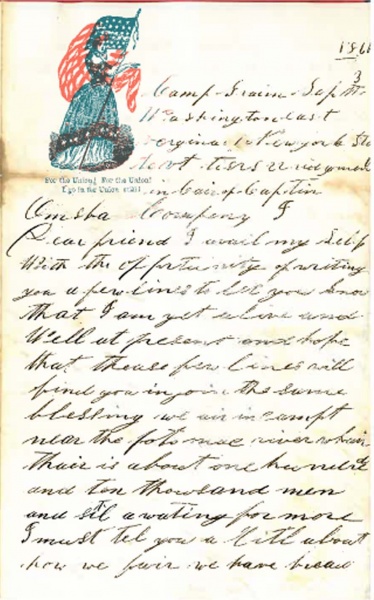
Dated Camp Graim Sep 3, 1861, Washington East Virginia, New York to the vt tiers 22 ridgment in Cair of Captain Omsha(?) Company F
Dear friend I avail my self with the oprtunity of writing you a few lines to let you know that I am yet live and well at present and hope that thease few lines will find you injoin the same blessing. We air in campt near the potomac river whair thair is about one hundred and ten thousand men and still awating for more. I must tel you a litl about how we fair we have bread and beef and bacan and rice and beans and what littl corn and potatoes we git on uncal Sam… Today we can hear the cannon and musket roar among the pickets to morrow we have got to go out on picket. I have had for shotes at the rebels and have cild one. It is a vury hard thing to shoote a man in cool blood but we haft to do it or we wold git shot ourselves. I wish I had your rifel hear and then I could take a longer shot at them Mostly I wold be vury glad to have you hear to go with me out on a scout to morrow. It is like huntin deer to hunt thease chaps. No more for this time. From your friend David Walker. Give my respects to Mr and Mrs. Baker and Juliet Baker and litel Jan an tel Jan… that I am afrad I never shal come back agin to ciss hur agin. David Walker You must write to me as soon as you get this. Give my respect to all folks in your naber hood.

The Transcontinental Railroad's Adirondack Connections

Like many marriages, the connection of the Union Pacific Railroad to the Central Pacific Railroad was commemorated with golden rings. To celebrate the completion of the Nation’s first transcontinental railroad in May 1869, San Francisco financier David Hewes made five gold rings out of a gold nugget that had been attached to the “Golden Spike” a commemorative piece used in the dedication ceremony.

The “Golden Spike” or “The Last Spike” symbolized the end of the railroad’s construction and the beginning of coast-to-coast rail service in the United States. Along with President Ulysses S. Grant and Secretary of State William H. Seward, Rev. Dr. John Todd, who conducted the invocation at the May 10, 1869 dedication ceremony, received this historic token. Dr. Todd was a friend of railroad tycoon Thomas Durant (father of Great Camp builder William West Durant) and a lover of the Adirondacks. Dr. Todd wrote Long Lake in 1845, a book about his adventures in the North Country wilderness from 1841-1844.

Thomas Durant was the Vice President of the Union Pacific Railroad before he and his family set their entrepreneurial sights on the Adirondacks. The ring owned by Dr. Todd is now in the Adirondack Museum collection.

A Month in the Life: Lucelia Mills Clark

“Clear and pleasant and not very cold” was March 1898 according to homesteader Lucelia Mills Clark. In addition to taking note of the weather every day, Lucelia recorded the hardships and bright spots of life in the Adirondack Mountains. In between rearing eight children and doing countless farm chores & household tasks, Lucelia kept a daily journal for almost forty years. This incredible account chronicled her family’s experience as early settlers in the Cranberry Lake region and is now housed in the museum’s archives. In celebration of National Women’s History Month, the museum presents these entries for the entire month of March 1898.

March 1898

Tue 1 Clear and pleasant and not very cold. H. went guming1. I dyed 4 pair of stockings and two pair of mittens & made Merton a pair of pants. Have a cold all of us. Just a year since I began to keep a diary.

Wed 2 Cloudy in morning but pleasant in p.m. Arthur went guming. H. went to barrell out the road between here and the farm2. I have spun 20 knots3. hard cold. snif. snif. snuf & sneeze. for the last two days.

Thurs 3 Pleasant and thawed in the sun H went guming. Arthur shoveled out the arch as it acts like sugar weather4. I finished my spining.

Sat 5 Yesterday was pleasant & warm. H. went guming. I did some cooking and washed out a dress for Gladys and mended a pair of pants and we all went down to Mac’s to a dance5. we stayed until daylight. There was a croud numbering 60. children and all 18 of the latter. came home got breakfast did up the work and went to the lake with H. he went to draw stove. guess we shall sleep tonight

Pass right through and ballance again and swing with the girl behind you.

Sat. colder and cloudy

Sun 6 Very pleasant. Chans folks were all over here. Arthur drove down to the mill. Archie came down and went down to Mac’s with him. H. went down to Mac’s this morning came right back

Mon 7 Warm & pleasant. I washed. Lena twisted yarn6. H. went guming in a.m. Arthur went down to Hamiltons after the 3 gallon jug in p.m. Randolph came over to go to Russel with in the morning [sic]. Heard Ina Shurt-leff was married yesterday.2 year old [calf] came into the woodshed and jumped out through the window.

Tue 8 Warm & pleasant. H. & Randolph start-ed for Russell. I papered the bed room. Lena & Agnes went guming got about a pound. Steamed it out. Arthur got a stick of hoop timber. Churned.7

Wed 9 Warmer than ever. I straightened up the woodshed and planted some seed and worked. Arthur built a fire in the arch. H came back tonight. Lena sliped on the ice and hurt her back.

Thurs 10 Pleasant & warm. The men went to overhawling the [sap] buckets H went down to Mac’s to make hoops and I went with him. Carrie B. was there. Scattered some of the buckets and broke out the sugar road.

Fri 11 Pleasant but windy threatning rain. Taped the sugar bush or part of it. colared some yarn & stockings. and knit. Lena made a chair cushion

Sat 12 Rained nearly all day. Arthur went after the mail. H. fixed the rocking chair. I moped the floor all over. and made a chair cushion. got a letter from Bert8.

Sun 13 Rained part of the day. snow nearly all gone in the clearing wind shifted in p.m. and blew very hard from the west. Colder H & I took a walk up on the plains and salted a lick. Arthur went down to Mac’s with some letters to mail. I have laid around and read

first egg

Mon 14 Wind blew hard nearly all night but went down befor morning and turned cold. Thawed today. sun shone They finished tapping and gathered in what sap was in the bush Did not wash as my boiler is at Clifton

Tue 15 Pleasant but a cold wind. Boiled sap. H. went to Mac’s to get a boiler to sugar off in. Arthur hawled out manure

Wed 16 Pleasant and warmer with a high wind towards night and increasing H. went to lake. got sack flour. Arthur hauled manure. and he and the girls drove down to Mac’s to return the boiler. I sugared off 25 lbs

churned & sugared off 25 lbs.

Thurs 17 Hard thunderstorm last night and high wind. Syruped down. Pleasant but rather cold and windy. gathered sap and boiled all day.

Fri 18 Very nice day. H. went to Clifton Arthur Boiled sap till about 4 oclock. Then he got ready and went to the lake to a dance at Fred Loups. I washed all the forenoon. H. got back a little after 6 got the pan.

Sat. 19 Warm and rainy nearly all day. Hard thunder in evening. Arthur did not get home till most 4 oclock. Sugared off 35 lbs and put up 24 bottles of syrup. H. and Agnes gathered sap. moped the floor after 6 oclock

Sun 20 Spring begins with a high wind from the west Syruped down a batch. and H & I went down to Mac’s. Freezing

Mon 21 Warmer. and a good sap day. Men cut wood and I sugared off 15 lbs and filled 10 bottles. Mr. & Mrs. Hamilton were up this p.m. to eat sugar. staid till evening

Tue 22 High wind all day. Washed. and moped. The men cut sugar wood and boiled sap. Agnes found a nest with 13 eggs in it.

Wed 23 Rained all night. last night stoped at morning and the wind changed to the west. cleared off at sunset. cold. Sugared off 25 lbs. H. went down to Mac’s and got 26 lbs pork. Arthur went to the lake horseback. I have been sick all day. Lena laid up all the forenoon. Arthur just got back

Old Mell had 2 lambs

Churned

Thurs 24 Pleasant but cold. Boiled sap and sugared off 25 lbs. Mr. Hamilton came up and brought his beartrap. Randolph came over and Agnes went back with him. am about sick.

Fri 25 Pleasant. Sugared of 30 lbs. Mac was over just as it was ready to come off and stayed to eat some. Arthur went over to the sugar party at Chan’s. They cut schoolhouse wood. Don’t feel much better

Sat 26 Pleasant but windy. H. gathered sap and boiled. Arthur got home about 11 o’clock. got a letter from Em and Seba(?) a man buying deerskins and a boy were here to dinner sold him 4 skins and got two pair of gloves.

Sun 27 Pleasant and windy. White cow calved. H. went to Surtleffs [sic]. got his pay— $3.50. We girls went off in the woods after moss. Syruped down a fine batch of surup.

Mon 28 Rain and wind all day. first one then the other. then both. Sugared off 30 lbs. Boiled sap and H. went to the lake. Ice went out yesterday. The earliest it was ever known to go out. Agnes came home today. Sent for garden seeds. Agnes & my birthday Mollie gave me a wall pocket.

Churned

Tue 29 Rainy. Sugared off 30 lbs. Boiled sap. Moved the stove into the shed. H. put a new window in the shed. Arthur went up to the camp after some stovepipe. got some white violet plants.

Wed 30 Pleasant. Sugared off twice 50 lbs in all. Mr. Hamilton came up in the forenoon to set some bear traps. Was here to dinner. Mrs. MacAleese came up in the afternoon afoot and brought the children. Mr. M. came up with the team later. They plowed the garden. and drew a load of wood to the schoolhouse.

Thurs 31. Pleasant but cold. I washed. H. took some wood to the schoolhouse and set up the stove. then gathered up the sap I finished up the day mending pants.

  1. “H” is Henry Clark, Lucelia’s husband. Like many other Adirondackers of the time, he made a little extra money-gathering spruce gum in the wild. It was then melted, cleaned of twigs and debris, and cast into little bits for sale as chewing gum.
  2. Dragging a barrel behind a horse was a substitute for rolling or plowing the snow. Arthur was Henry and Lucelia’s second son.
  3.  A knot is a measure of thread or yarn spun— usually 80 yards. Lucelia was spinning knitting yarn.
  4.  A major source of income for the Clarks was maple sugar. They generally had about 300 taps.
  5.  William MacAleese was an Irish immigrant who ran a farm for the Canton Lumber Company near Clark’s. Historian Jeanne Reynolds wrote “Many a happy night was spent at “Mac’s” farm, which became noted for impromptu square dance parties and plenty of food.”
  6.  Lena was the Clark’s fifth child and about 15 in 1898. She was plying the yarn her mother had spun.
  7.  Lucelia Clark made butter for home use and for sale in Cranberry Lake. This is an early churning; the cows were “dried off” in the winter.
  8.  Elbert Vedder was the Clark’s oldest child. He had left home around 1890 and later in life became an expert locksmith with a professional relationship with Harry Houdini.

Mining in the Adirondacks

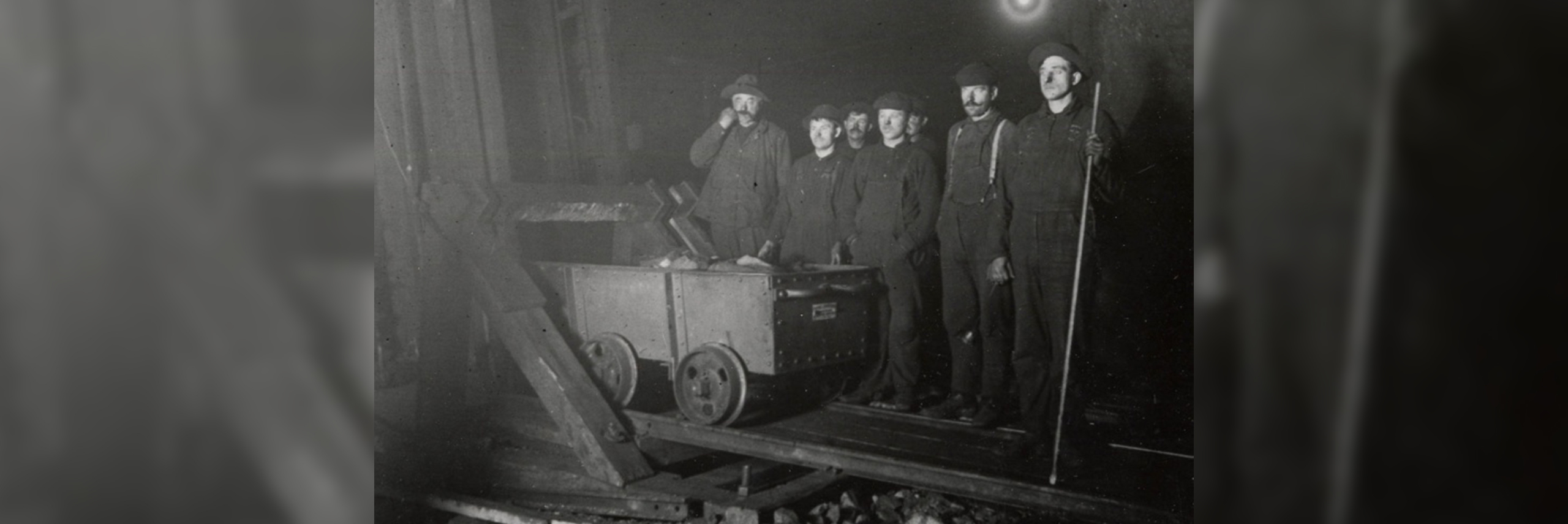
Most visitors to the Adirondack Park are unaware that mining was once a major industry and employer in the region, or that it brought an ethnically diverse population of workers into the Park. At places like Tahawus and Mineville, once enormous industrial sites, are slowly being reclaimed by nature, hidden by wilderness. The history of Adirondack mining— and of the people who lived and worked in its shadow— has become largely invisible.

Company employment records document French-Canadian, Spanish, Irish, Lithuanian, Russian, Columbian, German, Argentinean, Welsh, Italian, Norwegian, Hungarian, Syrian, Swiss, Japanese, and Finnish miners working alongside their American-born (white, black, and Native American) counterparts in Adirondack mines.

Company recruiters brought new immigrants right from the docks of New York City to the Adirondacks. In larger company towns, as each new immigrant group arrived, the more established miners moved up, occupying supervisory positions and better housing. Newer immigrants were assigned the least desirable and most hazardous jobs.

A sense of community could be difficult to create and maintain, and small Adirondack mining towns often experienced the ethnic discrimination and violence more commonly associated with larger, urban areas. Companies like Witherbee-Sherman designed their towns with ethnically segregated housing— exacerbating tensions between old and new immigrant groups— which served to reduce the chances of miners finding common cause and striking, or, worse, unionizing.

In the late 19th century, established Irish mine workers, many of whom had graduated to supervisory positions, occupied the most comfortable company housing. New, poorer immigrants were assigned to multi-family tenements. Abuse was common: Irish foremen told their Italian workers they had to pay for their own tools (which the company actually provided at no cost) and imposed pew rents in the local parish that new immigrant workers could not afford. The Italian “La mano nera,” (the Black Hand), engaged in arson, intimidation, and extortion, terrorizing Moriah in the early teens.

To ease tensions and relieve boredom, mining companies sponsored baseball teams, mother-daughter dinners, card parties, dances, and holiday parties. Alice Hooper Tibbets recalled “hayrides and sleigh rides under the stars, births, Christenings, weddings, funerals, sewing bees, amateur plays, Easter egg hunts, political meetings, morning prayers… war-time speeches, card games, and… musical entertainment, with an organ, a violin, a harmonica, and bone rattling.”

Many Adirondack mining towns have disappeared or are greatly diminished, but the ethnic diversity mining brought to the region remains. Names like Calabrese, LaBier, Farrell, Donahue, Emru, Fagerberg, remain part of the Adirondack community. Food traditions, like French-Canadian meat pies and German sauerkraut, are recognized as regional favorites.

A.A. Low's Empire

The Adirondack region is a place of natural beauty and also a region of industry and invention. Many people have carved out lives in these quiet woods, some creating great empires.

Abbot Augustus (A.A.) Low (1844-1912) is such a man. He left a lasting impression on the Adirondacks not only through the industry he built but also through inventions and innovations that revolutionized how people worked.

A.A. Low is best known for his business career; however, he spent much of his time working on new inventions. He received over 200 patents throughout his life. At the time of his death, he had been granted more patents by the United States government than any other person, with the exception of Thomas Edison. While the majority of Low’s projects served practical means, he was known to work on more whimsical and outlandish ideas such as an elaborate electric mousetrap and a submarine boat.

A.A. Low was born to a wealthy family of high social standing in Brooklyn, New York. His father Abiel Abbot Low (1811-1893) was a prominent merchant in the China trade. His brother Seth Low (1850-1916) was the president of Columbia University from 1890 to 1901 and the mayor of New York City from 1901 to 1903.

His father Abiel Abbot Low grew up as one of twelve children attending public schools. He would make his fortune when he sailed to China in 1833. By 1840, Abiel had launched the trading company A.A. Low & Brothers, which rapidly became one of the leading importers of silks and teas from China and Japan. Abbot A. Low apprenticed himself to his father’s shipping and importing enterprise, where he became a partner. However, his love of the Adirondacks would lead him to business ventures there.

Low first visited the Adirondacks in his teens but began buying tracts of land in the Bog River Flow area in 1892. He acquired nearly forty-six thousand acres, including Bog Lake, Lake Marian (renamed for his wife), Hitchins Pond, Horseshoe Lake, and Trout Pond. Most of the Bog River basin was purchased by 1896.

He was single-handedly responsible for the creation of the town of Horseshoe, in St. Lawrence County. It was the headquarters of the Horse Shoe Forestry Company, formed in 1896. The company initially headed Low’s logging operations, but other projects, such as bottling spring water and maple syrup production would eventually fall under the company’s management.

Low’s innovative spirit helped him overcome the difficulties of running a business in the rural Adirondacks. Many people would not have thought some of the projects he set in motion possible.

His first task, after establishing the Horse Shoe Forestry Company, was to build a railroad station at Horseshoe in order to conduct “proper” business. The station was far more elaborate than one normally found in the middle of the woods. It was a full-fledged depot with a telegraph and ticket office, and facilities for freight and express shipping. (The Quarterly: Official Publication of the St. Lawrence County Historical Association, Jan. 1974)

The railroad station was modeled after one located in Garden City, Long Island at the time. When the station at Horseshoe was complete, ownership was transferred to the Mohawk & Malone Railroad Company for one dollar.

Low was able to persuade the government to establish a U.S. Post Office at Horseshoe in January 1898. George Dukelow, the manager of Low’s first boarding house for employees, was appointed postmaster. (The Quarterly, Jan. 1974)

A.A. Low was always looking for more effective ways to do business. His thinking would lead him to build fifteen miles of standard gauge railroad track, purchase two locomotives, a steam shovel, a steam log loader, a steam crane and several flatcars to aid in the lumbering of his land. (Adirondack Life, May/June 1990)

To improve the efficiency of his lumber business, he also built a sawmill at Hitchens Park on the Bog River. Although portable sawmills to supply rough lumber were common, nothing on the scale of Low’s mill had been seen before in the mountains. The mill included a band mill that cut both hard and softwood. It also had all types of standard woodworking equipment along with special box and barrel-making machines.

Another example that shows how Low was ahead of his time was the 1899 project to bottle spring water and ship it to New York City. He shipped the water in square returnable bottles, another of his patented items.

1899 marked the beginning of Low’s maple sugaring business. This was another enterprise where Low’s knack for evolving systems is exemplified. The maple sap was not collected with traditional taps and buckets. Instead, pipes and troughs were used to bring sap to tubs near the railroad. It was then transferred to large tanks on flatcars and transported to the evaporators.

Even the evaporation process was revolutionized. Two men, James H. Hill and John Rivett, who worked for Low, developed a complex system where sap entered one side of the building, traveled through steam-heated evaporators, and came out the other end as syrup. (Adirondack Life, May/June 1990) Low submitted a patent for the design in the names of the two men.

Low’s next big project would be to build a dam on the Bog River to help with log drives and generate electricity. The first dam was built in 1903, but the scale of Low’s ambitions required more power than a single dam could produce.

In 1907 the second “upper dam” was built near Hitchins Pond. The completed dam raised the river more than six feet, creating a conflict with the state, which claimed ownership of the land. It was not until well after Low’s death that it was determined that the state did not in fact own the flooded land.

The Horse Shoe Forestry Company was strong in 1908, but in the fall a number of devastating forest fires ripped across Low’s lands. Sparks from railroad engines posed a constant challenge. The dry weather combined with the threat from trains resulted in a number of fires in the region. The great Long Lake West forest fire took place during this time (see the Adirondack Journal titled “The Adirondacks are Burning: A Brief History of Forest Fires”).

With much of his forestland destroyed Low’s lumbering and maple sugaring enterprises were no longer viable. Horse Shoe Forestry Company was liquidated in 1911. The dams were reminders of the great industry that once operated there. A.A.Low’s wilderness dams have left a lasting legacy. Paddlers today enjoy more than three scenic miles of unencumbered flat water on the Bog River between the Lower and Upper dams.

The Birth of Theme Parks in the Adirondacks

Spring in the Adirondack Park is a bustling time as local residents prepare for a flood of vacationers during the summer season. Memorial Day weekend marks the beginning of the tourist season for most businesses within the Park.

In an area where tourism is the foundation of economic activity, the amount of time and effort Adirondack residents devote to this season is of no surprise.

As soon as the snow melts and the ice goes out, people employed in the tourist industry busy themselves in various ways; hiring and training new staff, cleaning and opening seasonal camps, distributing advertisements and brochures, and reopening ice cream stands, motels, and marinas.

Thousands of visitors are drawn to the Adirondacks to relax and play in this alluring region. Bountiful outdoor experiences are available such as camping, swimming, hiking, boating, or relaxing in the sun.

Many may not realize that this pristine wilderness region full of opportunities for outdoor recreation, is also the birthplace of the theme park, with a rich history of providing man-made entertainment for visitors and residents alike.

One of the earliest amusement parks in the Adirondacks originated as a picnic area developed by the Fonda, Johnstown, and Gloversville railroad line to attract patrons. F.J. & G. sought ways to revive the Gloversville and Northville line, located in the northeastern corner of Fulton County, New York.

What would become Sacandaga Park, ironically known as the “Coney Island of the North,” began as picnic grounds for hire near Northville, N.Y. In 1888 the Adirondack Inn was built with rooms for 250 guests and an elevator, which was a rarity for Adirondack resorts. Cottages quickly sprung up around the Inn.

After a fire in 1898 destroyed all but nine of the 120 cottages, railroad officials quickly cleared the rubble and transported materials at no cost to residents whose property burned. The railroad men now envisioned redeveloping more than a glorified picnic area. The first additions would be a theater and regulation nine-hole golf course.

Next, the railroad formed the Sacandaga Amusement Company, building a huge midway with a rollercoaster, two carousels, a shooting gallery, and a house of fun. In 1901, a new picnic area was constructed along with a grandstand and baseball diamond that was later home to the New York State Baseball League. There was a miniature train connecting the island where the grandstand was located to the midway. The theater attracted famous talents such as Al Jolson, Zazu Pitts, and W.C. Fields.

However, multiple fires and a decline in railroad use plagued Sacandaga Park. The popularity of this resort was short-lived, with more and more vacationers abandoning railroads in favor of the individual mobility offered by automobiles. Then the midway burned in 1912 followed by the grandstand in 1918.

The final blow to the park came in 1926 when the Hudson River Regulating Board condemned the property in preparation for a reservoir to control flooding on the Hudson River. Much of the land that was Sacandaga Park now lies underneath the Sacandaga Reservoir.

In the 1940s and 50s, a new generation of parks emerged. Not focused on rides, these “theme parks,” designed around a single idea, were the first of their kind in the nation. The very first was the North Pole, located in Wilmington, N.Y. The instant popularity of the North Pole is credited with the development of theme parks throughout the country, including Disneyland.

In 1947, artist and toymaker Arto Monaco was approached by a man named Julian Reiss with an idea for a theme park designed around the beloved story of Santa Claus and his workshop. The North Pole was an immediate success, opening to an unexpectedly large number of visitors in 1949.

The popularity of the North Pole lead to Reiss’s Old McDonald’s Farm in Lake Placid, N.Y. and Monaco’s “Land of Makebelieve” in Upper Jay, N.Y.

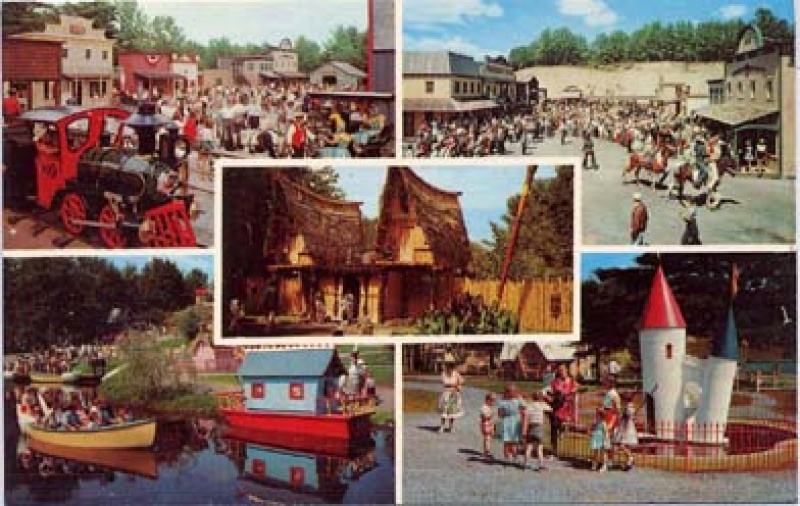
Over time there have been a number of theme parks to delight visitors throughout the Adirondack Park, including Frontier Town, a “cowboy town” in North Hudson, N.Y. aimed at preserving the history of frontier life. Attractions such as Gaslight Village, “Ghostown,” Magic Forest, and The House of Frankenstein Wax Museum, all located in Lake George, have added to the entertainment of Adirondack visitors.

While some of these theme parks have closed over the years, there are still a number that continues to attract visitors and provide amusement for kids and adults alike. The Great Escape, a theme park located near Lake George, has incorporated pieces from parks that have closed, such as Gas Light Village, Storytown, and the “Land of Makebelieve.” The Adirondack Park is also home to New York’s largest water theme park. Enchanted Forest Water Safari in Old Forge, N.Y. delights guests with an array of water rides and a theme village reminiscent of Monaco’s original creations.

Summer in the Adirondacks draws all kinds of people. From exploring natural wonders to visiting unique man-made attractions, there are many ways to spend time in the Adirondacks. Millions of tourists come year after year. And so, year-round residents work each spring to ensure wonderful summertime experiences for vacationers.