
Maple Syrup in the Adirondacks

Did you know that New York State is the third-largest producer of maple syrup in the world and is the second largest in the United States? Currently, Canada leads production with Vermont in second place.

As winter gives way to spring, maple syrup producers go to work. The sap starts flowing when temperatures climb above 40 Fahrenheit during the day and fall below freezing (32 F) at night. In Northern New York this generally happens between late February and early April.

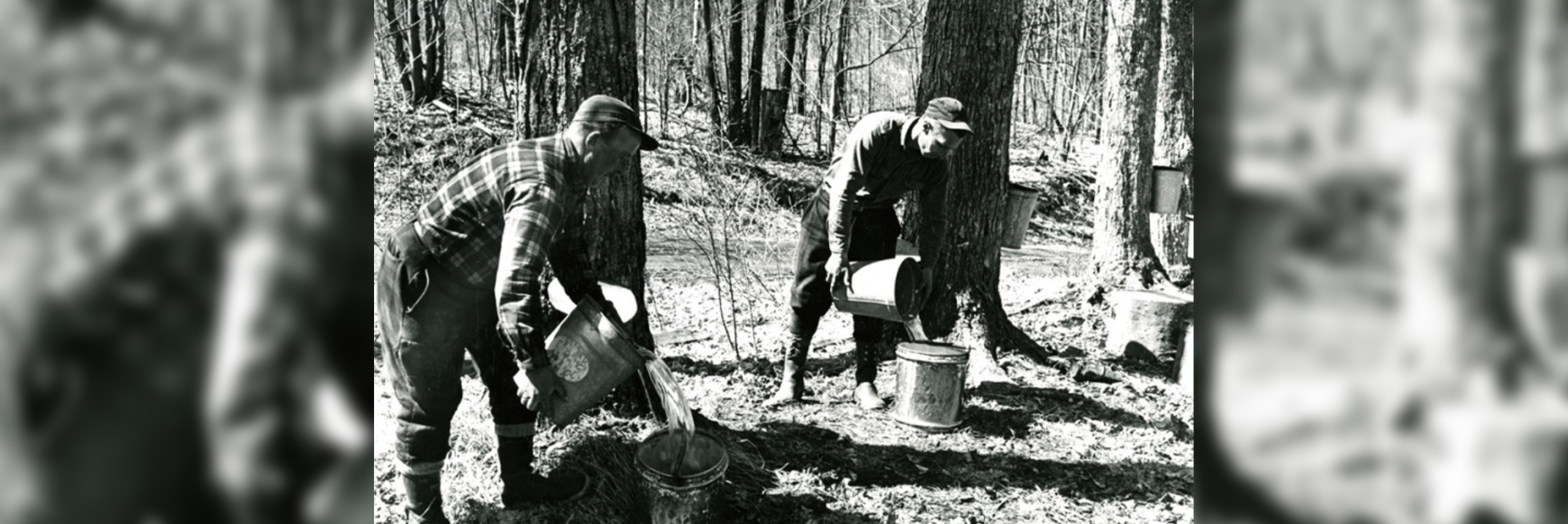
During this time of year, it is not uncommon to venture down a side road in the Adirondacks and see metal buckets hanging from sugar maple trees. These “sap buckets” belong to individuals who make homemade syrup.

Maple syrup production has a long tradition in the region. Native Americans made maple syrup before Europeans arrived in North America. An Iroquois legend credits the beginning of maple syrup production with Chief Woksis.

As the story has it, one March day Chief Woksis threw his tomahawk into a maple tree. The next day when he retrieved it, the weather had turned warm and the gash dripped sap into a container that was near the tree. When the chief’s wife went to collect water from the river, she found the container with something that looked like water in it. She tasted the liquid and found it to be sweet, so she used it to cook with. The “water” boiled to syrup, beginning maple syrup production. (mapleweekend.com)

The traditional method of collecting sap involves “tapping” a tree, or drilling a hole where the metal tap goes. The sap flows from the tree through the tap into a metal collection bucket.

Larger producers have moved away from this method of collection. In order to harvest a greater amount of sap more efficiently, the maple trees in the sugar bush, a grove of sugar maple trees used for syrup making, are tapped and connected to a network of plastic tubing that takes the sap to collecting vats. Rather than having individual buckets on each tree, the tubing network brings the sap from every tree to one location, the collecting vat. From here the sap travels to the sugarhouse.

At the sugarhouse, the sap is boiled to remove water and yield the sugary syrup. In most cases when sap leaves the tree it contains 1-6% sugar. The final product, maple syrup, is 66-67% sugar.

There are many types of evaporators used to make maple syrup, the most traditional is a wood-fired evaporator. The basic method collects the sap in pans, which are heated by a wood fire, and the water boils off leaving behind the sweet syrup.

In modern production, there are far more fuel-efficient methods of evaporation than the wood-fired evaporator. Because fuel prices account for the greatest portion of manufacturing cost, maple producers are always looking for more efficient methods of evaporation. The Cornell Sugar Maple Research & Extension Program website is a great resource to view the various evaporation methods available.

In order to get one gallon of syrup, it takes 43 gallons of sap with a 2% sugar content. This means that 42 gallons of water need to be boiled off from the sap to achieve maple syrup.

Weather conditions, the size of the tree, the length of sap season, and the method of collection all factor into the amount of sap a tree will produce. A single tree can have 1-3 taps depending on its size and health.

The Adirondack Museum has close to two hundred objects related to maple syrup production in the area. Among the collection are wood and metal sap buckets, yokes for carrying sap buckets, sap pans, handmade chisels used for tapping trees, wooden sap spiles or taps, and many other unique items once used in syrup making.

If global climate changes continue as predicted, there will be a severe impact on the sugar maple trees in the region. Sugar maples are extremely sensitive to their environment, and an increase in annual temperature could mean a gradual decline in the number of sugar maples. Sap production is highly dependent on temperature, most specifically the number of days above 40 F and nights that fall below freezing. The environment determines not only sap production, but also the sweetness and water content of the sap.

There is a high demand for maple syrup worldwide, creating shortages and keeping the price of syrup high. Many believe that New York should reclaim its role as a leading maple syrup producer. This long regional tradition could be a way to improve the economy through producing and exporting a natural product.

Advice on Eating in Camp

Enjoying a meal around a campfire is an important part of an outdoor experience. Many a camper insists that food just tastes better when eaten outside.

An anonymous sportsman wrote about his trip to the Adirondacks in 1867, with particular mention of meals: “Trout ‘Flapjacks’ & corn cakes were soon cooked… and then we hurried into the Tent to eat, for the Mosquitos were very troublesome outside, & threatened to devour us, waving [sic] all objections as regarded our not being Cooked. The next morning we were up early & had such a Breakfast. Venison nicely cooked in a variety of ways great blooming Potatoes, splendid Pancakes with maple sugar syrup, Eggs, & actual cream to drink… We could scarcely leave the Table…”

Cooking outdoors can be as much fun as eating, but for those who prefer the comforts of modern appliances, it may present a challenge. Thousands of guidebooks have offered advice and recipes to would-be Adirondack camp cooks for more than a century.

In 1869, William H.H. Murray inspired thousands of novice sportsmen to try their hand at camping in the Adirondack Mountains. His book Adventures in the Wilderness offered advice on how to get there, what to wear, how to find a guide, where to hunt and fish. His suggested list of provisions was basic: “All you need to carry in with you is Coffee, Pepper, Tea, Butter (this is optional), Sugar, Pork, and Condensed Milk… If you are a ‘high liver’ and wish to take in canned fruits and jellies, of course, you can do so. But these are luxuries which, if you are wise, you will leave behind you.”

Murray insisted, “I do not starve” while living in the woods. His Adirondack diet consisted primarily of potatoes (“boiled, fried, or mashed”), venison in various forms, trout, pancakes, bread (“warm and stale”), coffee, and tea.

Nearly a half-century later, Horace Kephart wrote The Book of Camping and Woodcraft. Kephart’s intended audience was male sportsmen traveling in a small group for an extended stay in the woods. He offered “ration lists” for each season, for four men on a two-week stay, for heavy and light meals. The amount of food listed would have given Murray pause. Salt pork, canned corned beef, fresh eggs, butter, cheese, lard, rice, macaroni, flour, onions, beans, canned tomatoes and corn, coffee, tea, cocoa, sugar, maple syrup, dried fruit, raisins, canned peaches, shelled nuts, and a lengthy list of condiments could be hauled to camp in lightweight chests or pine grocery boxes. He also recommended bringing a cookbook.

Kephart advised his readers that “poor cookery is not so much the result of inexperience as of carelessness and inattention to details… A bad mess is sure to follow from (1) a poor fire, (2) seasoning too much or too early in the game, (3) too little heat at the start, or too much thereafter, (4) handling or kneading dough made with baking powder; and it is more likely than not to result from guessing at quantities instead of measuring them.”

His recipe for oatcakes: “Mix ½ pound of oatmeal, 1-ounce butter, and a pinch of salt with enough water to make a moderately thick paste. Roll to a thickness of 1/3 inch, bake in frying pan, and give it to a Scotchman- he will bless you.”

Although authors J.C. and John D. Long reassured insecure camp cooks in the 1920s that “after the camper has been out for a week he will almost be able to eat, like, and digest gravel,” they also underscored the importance of meals to the outdoor experience: “To the average person much of the enjoyment of …camping will depend upon the quality of the meals that are supplied. If the day be started with a good breakfast of steaming coffee, a rasher of crisp bacon with hot flapjacks and crisp fried potatoes, the day is well begun and everything else is likely to pass off delightfully. But begin with dishwater coffee, lukewarm in temperature, soggy, half-done flapjacks, soft, stringy bacon and limp, greasy potatoes, and the rest of the day will be equally distasteful.”

The Long’s 1923, book, Motor Camping, included detailed instructions for making a fire, maintaining a balanced diet, a description of essential food supplies, and suggestions about where to purchase groceries while on the road.

Their recipes, written for campers traveling by car, were simple by today’s standards but involved more ingredients and more perishables than Murray could have recommended. Heavy jars and cans, provided they were packed to avoid breaking, were easy to transport in an automobile. Camp stoves fueled by oil, gas, kerosene, or solidified alcohol provided alternatives to cooking over an open fire. Groceries were available for purchase at roadside establishments that sprang up across the Adirondacks to cater to the motoring public.

The Longs anticipated that most campers, regardless of nearby grocery stores, would procure at least some of their food in much the same way that 19th-century sportsmen had done. Their cooking instructions include recipes for fish and small game, particularly squirrels: “Squirrels should be broiled, using only young ones. After skinning and cleaning, soak in cold salted water for an hour. Wipe dry and place on a grid with slices of bacon laid across for basting. To fry old ones, parboil slowly for half an hour in salted water and fry in fat or butter until brown.”

‘Dack Doodles: Exploring Adirondack Illustrations, The Artist and The Blizzard

As anyone who has lived in or visited the Adirondack Mountains in the wintertime knows, snowy and cold weather conditions are a fact of daily life here. The Adirondack Experience Library is full of personal accounts of brave souls grappling with gusty winds and subzero temperatures in hopes of reaching a cozy fire back home. Among these is a narrative from an unusual source – the painter Thomas Hart Benton, who in 1927 described his ordeal battling an Adirondack blizzard.

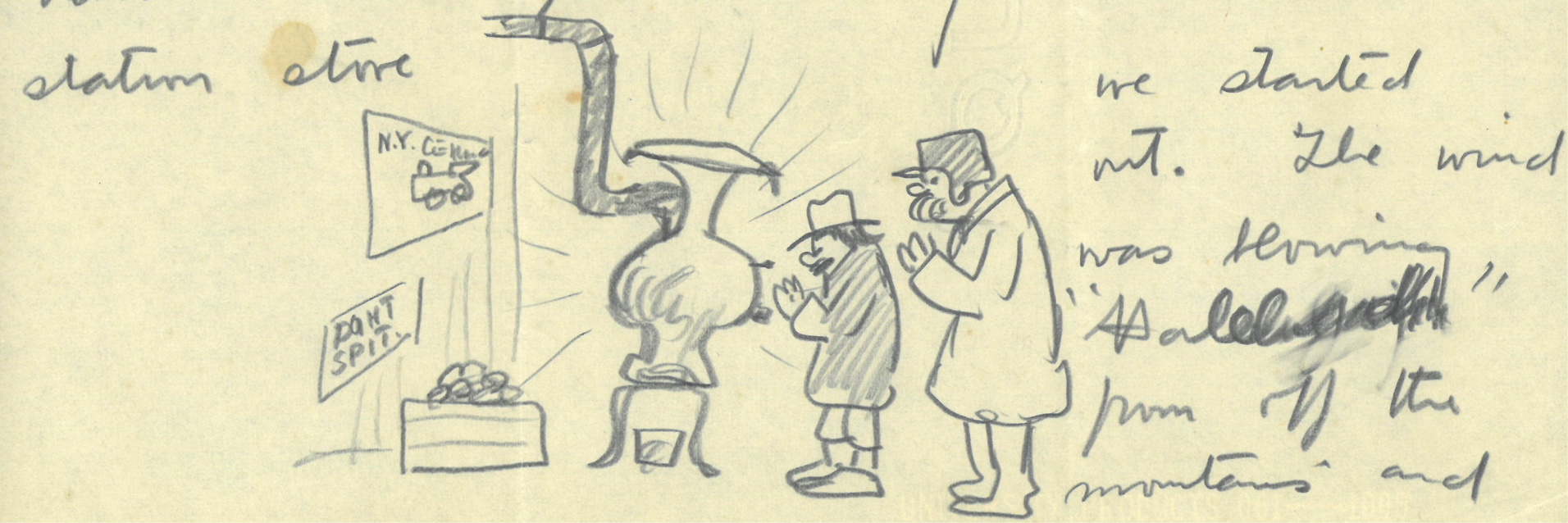
Not typically associated with the Adirondacks, Benton is known for his stylized murals vividly depicting the lives and struggles of everyday Americans from the rural Midwest. In the 1920s he was living in New York and teaching at the Art Students League there. A visit to a friend with a farm in the Adirondacks, identified as Dr. Raabe, prompted Benton’s wintertime sojourn into the mountains. In a letter to his nephew Nat Briggs, Benton describes – with illustrations – his harrowing journey:

“It was a long ride on the train. I left New York in the afternoon when it was just beginning to snow. By the time I got to the station where Dr. Raabe was to meet me a great blizzard was on and the snow was piling into enormous piles much higher than your Paw’s head.”

Benton goes on to describe Raabe’s sleigh, laden with heavy blankets for warmth, and the four-mile journey the two would undergo to get to Raabe’s estate.

“We hadn’t gone a half mile before I had to get out of the sleigh and try to tie my ears with my muffler. Every time we turned a corner so that the wind hit us in the face we felt as if some lady was rubbing rough ice against our skin. Cold!!! … My ears were already frozen and my toes and fingers, even through shoes and gloves, were on the way. If something had hit my ears they would have broken off like glass. We were mighty worried.”

As they finally approach Raabe’s homestead through whiteout snowfall and bracing winds, the doctor steers their sleigh into the relative calm of an apple orchard, only to get lost among the trees. They eventually catch sight of a fence that will lead them to Raabe’s house, but a stump hidden under snowdrift breaks their sleigh’s harness. They would have to complete the journey on foot, pulling their horse behind them:

“Well to make the story short we got there. But you should have seen us. Our eyes were closed with the snow and ice. Icicles, inches long, hung from our moustaches and we were white as the frost kings. It took a long time to thaw us out but after a while we began to melt and then we had hot soup and got all warmed up and went to bed and slept like we were dead.”

Benton’s accompanying sketches, pictured here, comically capture the duo’s misadventure. To look at these and thousands of other items in-depth, contact Library Director Ivy Gocker at igocker@theADKX.org, or visit our online catalog at http://adirondack.pastperfectonline.com.