Kidnapped in Northern New York

New York abolished slavery in 1827. However, the state was not rid of those who believed in profiting from the selling of human lives. Free black men and women had to remain cautious of kidnappers. Hired slave hunters who sought fugitive slaves for return to the south continued to threaten the freedom the North represented.

While kidnapping of free blacks was less common in northern New York because of its distance from Southern slave states, it did occur, as is evident in the story of Solomon Northup.

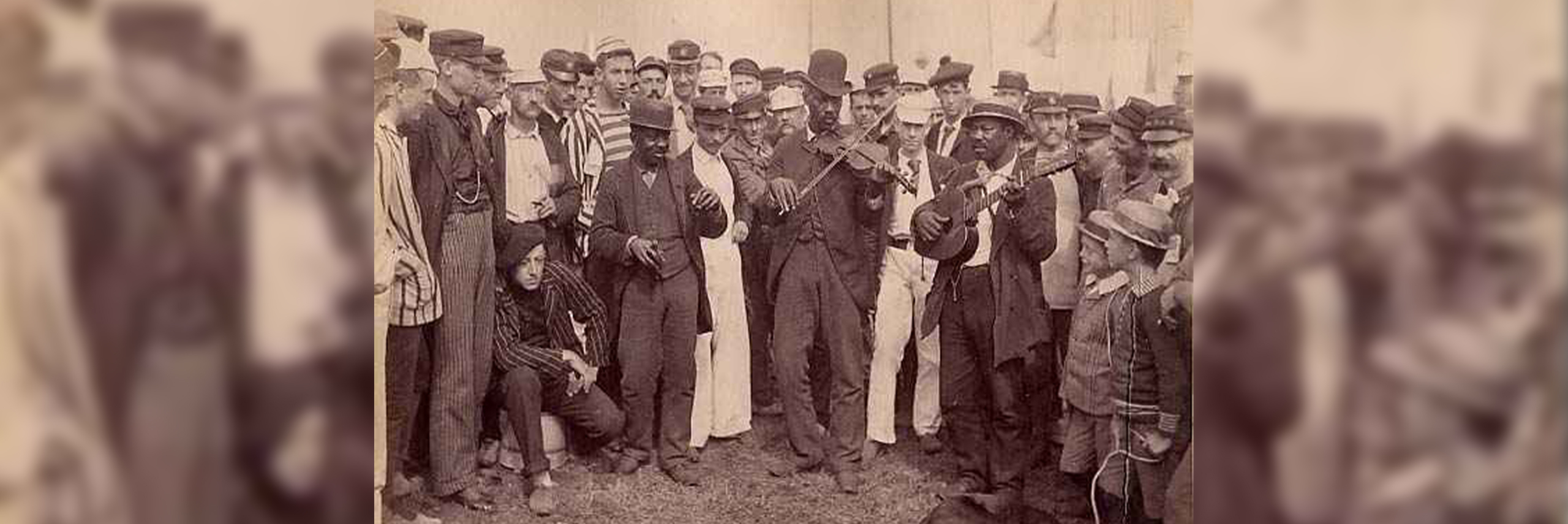
Solomon Northup was born free in the Adirondack town of Minerva, New York in 1808. While living near Saratoga Springs, N.Y., Northup, then 33, was approached by two men named Brown and Hamilton who offered him work as a musician in a circus. After doing odd jobs at the United States Hotel in Saratoga Springs, this seemed like a lucky opportunity for the fiddle player.

Brown and Hamilton convinced Northup to travel to New York City and work on a show to advertise the circus. From there the pair urged Northup to accompany them to Washington D.C. for the circus job. They purchased papers attesting to Northup’s status as a free man for his travel to Washington.

However, Brown and Hamilton did not have as trustworthy motives as Northup believed. The men he thought were friends drugged him while drinking together, took his money and “free” papers. When he awoke, Northup was in chains and being sold into slavery.

Northup’s slave name was changed to Platt. A man from Louisiana named William Ford purchased him for nine hundred dollars. Ford was a fair man and the tasks he assigned Northup were quite lenient for slave labor.

However, Ford went bankrupt and sold Northup to a planter named John Tibeats who turned out to be a cruel and harsh master.

On more than one occasion Northup fought off unprovoked attacks by Tibeats, once striking back so forcibly he fled into the swamps to avoid the consequences of an act that could be punished with death. Even the dangerous swamps full of alligators, water moccasins, and wildcats seemed a better option. He miraculously was able to find his way to Ford’s plantation seeking shelter.

Unfortunately, Ford was unable to purchase Northup back, but he could intervene and convince the brutal Tibeats to hire him out to less abusive masters. Tibeats eventually sold Northup to a planter named Edwin Epps. This change did little to improve Northup’s position. When he wrote of that time, he recollected thinking of escape every day but realizing the attempt would be futile.

Northup was enslaved for twelve years; the final ten with Epps. Northup’s luck would turn around in 1853 when Samuel Bass, a white Canadian-born man, came to work for Epps. Bass held unorthodox beliefs about slavery and often lectured his boss about the ills of the system.

In order to avoid beatings, Northup had not told others of his free birth standing. However, he eventually confided this information to Bass, who promised Northup his assistance. Four letters were sent to Saratoga Springs on behalf of Northup, requesting that the recipients send his free papers to Louisiana. One of the letters found its way to Northup’s, wife who brought it to a family friend named Henry Northup, a prominent Fort Edward, N.Y. lawyer.

Henry Northup’s last name was no coincidence; he was a long-time friend of the Solomon Northup family. His slave-owning ancestors in Rhode Island had been the masters of Solomon’s family and the source of his family name.

Henry Northup was able to obtain affidavits and received support from the governor of New York to retrieve Northup under a law established to recover illegally enslaved free blacks. The lawyer traveled south but had initial difficulty locating Northup because he did not know to look for “Platt,” Northup’s slave name. However, by finding Samuel Bass he was finally able to reach Solomon Northup.

Solomon Northup would go on to tell of his experience in the book Twelve Years a Slave, ghostwritten by David Wilson. His story was also adapted into an award-winning film of the same name in 2013. The story of Solomon Northup represents just one example of how far this nation has evolved. We are no longer a country that enslaves, and events that could not be imagined even a decade ago have come to pass. While we are slowly chipping away at longstanding discrimination and moving in the right direction, there is still much to be done.
A Dip into our Boat Collection

The Adirondack Museum is known for its large and varied collection of boats used to navigate the many lakes and rivers of our region. The collection includes an inboard launch named Vic, a 1933 Hickman Sea Sled, a Grumman aluminum canoe owned by Homer Dodge, a Raider model Adirondack guide boat built by H.D. Grant, an Adirondack guide boat built by Theodore Hanmer, and a 1910 William Vassar guidebook, among many others. These boats are examples of the region’s rich boating history and add to the story of watercraft used in the area.

Inboard Launch Vic

In 1918, John Otto Betz purchased “Battleship Rock,” property at the outlet of Seventh Lake, New York. In the same year, he also purchased a small inboard launch and named it in honor of his wife, Victoria. Vic was built by Moxley Motor Boats in Cos Cob, Connecticut. It is a 14-foot long inboard launch with a two-cylinder engine from the Lockwood-Ash Company of Jackson, Michigan.

Moxley Motor Boats began building wooden hulls to go with small gasoline engines during the first few decades of the twentieth century. In the 1930s the Great Depression, in combination with competition from large factories in the Midwest, but most small boat companies out of business, including Moxley.

1933 Hickman Sea Sled

Elizabeth Betz received a very special gift from her father, John Otto Betz, on her sixteenth birthday; a 1933 Hickman Sea Sled. The brand new, 16-foot long boat was intended for her use at “Battleship Rock”.

  1. Albert Hickman designed the Sea Sled in the early 1920s. They were fast, stable outboard boats with a revolutionary design that forever changed the small boat industry. The bottom shape of Hickman’s boats completely altered the conventional displacement-type hull: this boat had an inverted vee-planing hull instead. The design was the precursor of the modern high-speed catamaran and the Boston Whaler, common on many inland lakes.

Homer Dodge’s Aluminum Canoe

Homer Dodge, considered “dean of American Canoeing” in the 1960s and 1970s, owned this aluminum canoe. It was built by Grumman Boats, Inc. in Marathon, N.Y., and measured 16 feet in length. It has a mast step, but the rig has not survived.

Dodge ran the Long Sault Rapids in a boat similar to this in 1956. The Long Sault Rapids were a section of the St. Lawrence River west of Cornwall, Ontario that existed before the construction of the St. Lawrence Seaway. Dodge also competed in the 17th annual Whitewater Derby on the Hudson River at the age of 87 in this boat or one just like it.

Raider Model Adirondack Guideboat

  1. Dwight Grant of Boonville, N.Y. built this Raider in 1899 for William G. DeWitt, a New York City broker who had a camp at Little Moose Lake, N.Y., part of the Adirondack League Club.

Adirondack guide boats are generally thought to be most effective and fast when they are a certain length, generally 16 feet long. Raider guide boats are shorter and considered more maneuverable. The Raider is 12 feet and 8 inches long. Raiders were commonly used by one or two men to make a “raid” on distant, hard-to-reach lakes or rivers that had the best fishing.

Adirondack Guideboat

Theodore Hanmer of Saranac Lake, N.Y. built this boat between 1890 and 1910. It belonged to Henry “Hank” Blagdon who owned and ran Camp LaJeunesse, a summer camp for boys at Fish Creek Pond near Saranac Lake.

Theodore Hanmer moved to the Saranac Lake area in 1890. When he first arrived, he worked in Will Martin’s boat shop — but after a few months opened his own shop. He was still building boats into his eighties and finished over 200 in his lifetime. This Adirondack guide boat is 12 feet, 10 inches long, and weighs 59 pounds.

Camp LaJeuness operated between 1916 and 1956. The camp grew rapidly and had campers from many prominent New York families, including Sterling and Nelson Rockefeller. Influenced by the First World War, the summer program also included military training.

1910 William Vassar Guideboat

The 1910 William Vassar guidebook was an award winner in the Clayton Antique Boat Show at the Antique Boat Museum in Clayton, N.Y.  William Vassar was a well-known boat builder from Bloomingdale, N.Y. He was listed in the Saranac Lake business directory in 1902 and built boats through 1920.

Vassar’s boats were known for their extreme ram bows, which made them easy to spot from a distance. Many of his boats also had elaborate decks, commonly having alternating stripes of dark and light wood.

Spring Pests

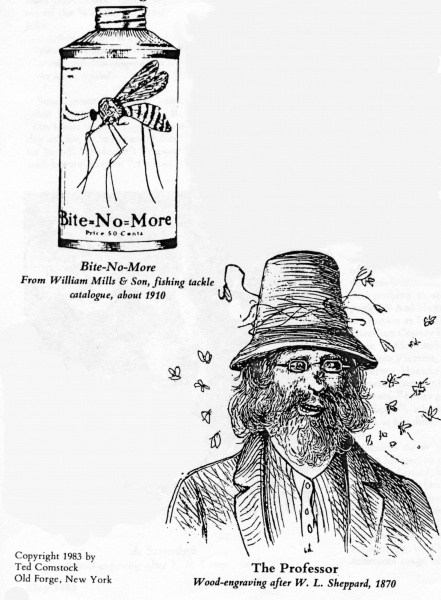
Enduring black flies is a test of anyone’s character. The ways in which people have coped with the months of May and June and these unwelcome spring arrivals have been extensively documented. There is even a black fly song!

May in the Adirondacks typically brings sunshine, warmer days, green grass, tree buds, daffodils… and the black flies.

Anyone who has spent time in the Adirondacks during the spring is aware that black flies have defined the season for as long as anybody can remember. During the nineteenth century, as recreational visitors began to enter the region, it was apparent that a remedy had to be found to ease the annoyance of the little determined bugs.

Countless repellents and home solutions have been invented to help discourage black flies. Just about any concoction, you can think of has been tried to relieve the nuisance of these pests (some a little more sophisticated than others).

George Washington Sears, better known by his pen name “Nessmuk,” recommended “a good, substantial glaze, which [he was] not fool enough to destroy by any weak leaning to soap and towels.” (Adirondack Life, May 1992) While probably effective, it may be best to travel alone when testing this remedy.

Another solution that may not always be practical but was sure to keep flies away was a smudge; a small fire intended to produce large amounts of smoke. Some, especially those native to the area, aimed at simply ignoring the bugs. However, when all else failed whiskey was not an uncommon aid in tolerating the pests.

Following the Civil War, the Adirondacks became a popular tourist destination, due to the inspiration of the Reverend William H.H. Murray’s book, Adventures in the Wilderness, published in 1869. These tourists were not used to “roughing it” and as a result, a greater need for bug repellent arose.

However, Murray himself would have his readers believe there was no bug problem in the Adirondacks and that there certainly was nothing to worry about when it came to black flies. He wrote of black flies as “one of the most harmless and least vexatious of the insect family…The black fly, as pictured by ‘our Adirondack correspondent,’ like the Gorgon of old, is a myth, — a monster existing only in men’s feverish imaginations.” (Adventures in the Wilderness, 56)

Despite Murray’s claim, black flies were a vexing problem from which people sought relief. Early repellants followed recipes that included anything from an ointment of petroleum to combinations of any of the following ingredients: castor oil, tincture of iodine, Vaseline, ammonia, kerosene, oil of peppermint, olive oil, turpentine, oil of tar, pine tar, or oil of cedar, to name a few. (Adirondack Life, May 1983)

Bug nets also emerged as a way to keep the pests away. Fine meshed nets covered the head and kept black flies from landing and biting. Today this solution has evolved and expanded to include improved fabric for tents and clothing to add extra relief.

Currently, DEET-based repellents are popular, however, there has been a shift towards using natural-based recipes with fewer harsh ingredients. Some people choose to also avoid wearing colors such as blue, purple, and red, which seem to attract black flies.

There has also been research into ways to prevent black flies before they have the opportunity to become pests. In 1982, testing of a new treatment known as Bti (Bacillus thuringensis israelensis) began in the Adirondacks. Many see this treatment as the best alternative to the previous method of aerial chemical insecticide spraying.

Bti treatments have proved to be an effective organic method targeting only the black fly larvae. However, it is a time-consuming process that involves careful study, trained technicians, and intensive work schedules in order to ensure successful treatment of streams and rivers at a precise point during the larva stage. It is quite costly. In 1988 there were only six towns in and around the Adirondacks that had adopted the treatment, by 2002 the number had grown to twenty-nine.

While some towns have adopted Bti treatments, there are still many areas that have not. The Adirondack Park, after all, covers six million acres of forest, lakes, and rivers. The black fly continues to plague many regions, requiring visitors and residents alike to use commercial “bug dopes” or some of the old-time methods described above in order to survive the season and simply hope for hot weather and the end of black fly season.

Abenaki People in the Adirondacks - Mitchell Sabattis

Mitchell Sabattis, Abenaki Farmer, 1855 

By guest writers Christopher Roy & David Benedict, 7 June 2009

While most people associate Abenaki people with the Odanak reserve on the banks of the St. Francis River in Quebec, Abenaki history is just as rooted in the Adirondack Mountains.

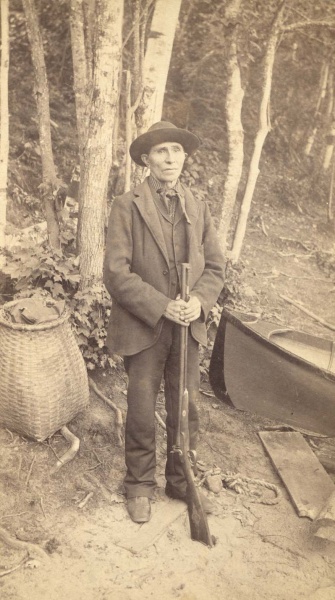
No Abenaki has figured as prominently throughout the history of the Adirondack region as Mitchell Sabattis (1821-1906). Famous guide and highly respected resident of Long Lake, New York, local history and old newspaper accounts are full of tales of Sabattis’ impressive knowledge of the natural world, of his wealthy clients, of the deer, panthers, and moose which he hunted, and of the impressive age which his father, Captain Peter, was reported to have attained (111 years).

His devout faith and sobriety have also been noted, often alongside a comment about his intemperance as a younger man. Rarely is much attention given to Mitchell Sabattis’ career as a farmer.

In his book, The Hudson: From the Wilderness to the Sea, Benson Lossing described the Sabattis property in “the old settlement of Pendelton, in the town of Newcomb, N.Y….between the head of Rich’s Lake and the foot of Harris’s Lake.” Lossing reported that in 1859 Sabattis “owned two hundred and forty acres of land, with good improvements.” Lossing’s tone was complementary — he clearly thought highly of Sabattis and his family — but provided little detail about Sabattis’ day-to-day life when he was not guiding.

Likewise, Lucius Chittenden wrote little of the family’s house and farm in Newcomb aside from its mortgage (which he acquired to save the family home). Chittenden’s account is associated with recollections of an 1846 sojourn in the Adirondacks, although some details of his account do not support such an early date (including a claim that young son Charles, then approximately two years old, was guiding the following winter). We do learn, however, that Sabattis hunted extensively to provide for his family and that the family took in boarders at some point after Chittenden’s visit.

A more complete (and reliably dated) accounting of the Sabattis farm is provided by the 1866 New York State Census. On June 4, 1855, the home of “Mitchael Sabbatus” was the fifth house enumerated in the town of Newcomb. It was a framed house worth $100 (four times the value of the log cabin where his brother-in-law and mother-in-law lived next door).

The head of the household was “Mitchael,” an Indian born in St. Lawrence County, a farmer, owner of the land, resident in the town for six years. Other family members included his wife, Elizabeth, and children Charles and John, born in Hamilton County, and Louisa, Isaac, and Solomon, born in Essex County.

Here is the agricultural data provided by the census:

Agricultural and Domestic Manufacturing Schedule

Size of Farm:

  • 20 acres improved, 140 unimproved

Value of Farm:

  • $700 cash value of farm
  • $90 cash value of stock
  • $50 cash value of tools/implements

Acreage in Production:

  • 4 acres plowed the previous year
  • 2 acres of oats, 50 bushels harvested
  • 1 acre of buckwheat, 12 bushels harvested
  • 1 acre of potatoes, 60 bushels harvested
  • 0 acres fallow the previous year
  • 6 acres pasture the previous year
  • 10 acres meadow, producing 3 tons of hay

Other Agricultural Products:

  • 5 gallons of maple molasses made
  • 80 lbs. of maple sugar made

Animals:

  • 1 under one year old
  • 1 over one year old exclusive of working oxen and cows
  • 2 working oxen
  • 1 cow
  • 1 cattle killed for beef
  • 1 butter cow produces 60 lbs. of butter
  • 1 swine over 6 months of age

In 1855, Mitchell Sabattis was a farmer engaged in a variety of agricultural pursuits, growing oats, potatoes, and buckwheat, raising a few animals, producing maple sugar. But this document leaves us with as many questions as it answers.

For instance, given his activities as a guide and hunter, what were the contributions of his wife and children to the family’s agricultural production? Did the family’s landholdings increase between 1855 and 1859, or was Lossing incorrect in attributing 240 acres to the family rather than the 160 recorded on the census? And when exactly did the family-run into the temporary financial difficulty about which Chittenden wrote?

Christopher Roy is an anthropologist conducting research on various Abenaki-related topics throughout the Northeast. David Benedict is an Abenaki family historian and descendant of Sabael Benedict’s son Elijah. They are actively seeking more information about Adirondack Abenaki history — feel free to contact them at caroy@pshift.com or d.benedict@roadrunner.com.

Abenaki People in the Adirondacks - Dan Emmett

Dan Emmett, Canoe Builder

By guest writers Christopher Roy & David Benedict, 15 June 2009

While most people associate Abenaki people with the Odanak reserve on the banks of the St. Francis River in Quebec, Abenaki history is just as rooted in the Adirondack Mountains.

To students of Abenaki history, among the most interesting artifacts of New York history to be found at the Adirondack Museum in Blue Mountain Lake is a birch bark canoe constructed by Daniel Wasamimet or Dan Emmett. Born December 29, 1871 near Joliette, Quebec.

Emmett would spend most of his adult life between Odanak, an Abenaki community in central Quebec, and Indian Carry near Corey’s in the northern Adirondacks, where he spent summers from 1909 until his death in 1953.

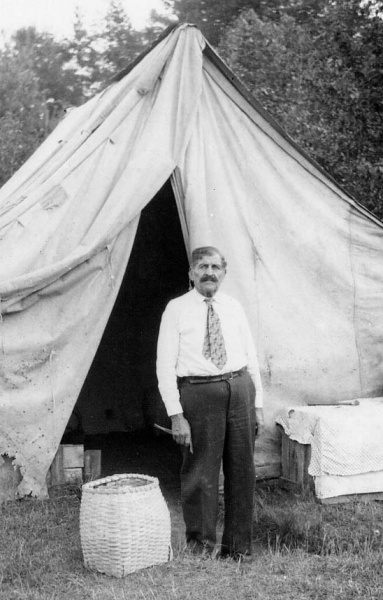
According to Clarence Petty, he first brought a number of women from Kahnawake with him to make the sweetgrass baskets which he sold. (We wonder if he also brought his wife, Adelaide Benedict, great-granddaughter of Sabael.)

About 1913 he began setting up his tent on State Forest Preserve land and working alone. Petty stated that Emmett “believed that no one owned the land…so he cut black ash for pack baskets and canoe ribs and peeled bark from white birch on [Petty’s] land and State land for the canoes that he made.”

Dan Emmett built the canoe in question for his friends, Anna and Avery Rockefeller, around 1928. It was maintained by Emmett until his death and was only paddled on Ampersand Lake. In 1990 it was donated to the Adirondack Museum. Another canoe that he built was documented in a 1955 article in Natural History. That canoe must have been made during one of the last summers of his life.

The canoe at the Adirondack Museum is a rare example of Abenaki boatbuilding and the only example of Emmett’s work we have located. It is an invaluable specimen of Abenaki canoe building technique, and a remarkable piece of Adirondack history. It is also an important reminder of an Abenaki man who continued to visit territories that his ancestors thought of as theirs centuries beforehand.

Christopher Roy is an anthropologist conducting research on various Abenaki-related topics throughout the Northeast. David Benedict is an Abenaki family historian and descendant of Sabael Benedict’s son Elijah. They are actively seeking more information about Adirondack Abenaki history — feel free to contact them at caroy@pshift.com or d.benedict@roadrunner.com.

Abenaki People in the Adirondacks - Maude (Benedict) Nagazoa

Maude (Benedict) Nagazoa, Proud Adirondack Abenaki 

By guest writers Christopher Roy & David Benedict, 15 June 2009

While most people associate Abenaki people with the Odanak reserve on the banks of the St. Francis River in Quebec, Abenaki history is just as rooted in the Adirondack Mountains.

In July 1960, about a year before her death, Rensselaer resident Maude (Benedict) Nagazoa donated ten items to the Adirondack Museum in Blue Mountain Lake. Together with items now in the collections of the New York State Museum and the Canadian Museum of Civilization, they comprise an extraordinarily valuable record of Abenaki material culture. The items at the Adirondack Museum include birch bark baskets, ash splint baskets, and items associated with the basket trade.

Maude (Benedict) Nagazoa was born at Lake George during the summer of 1880 into a basket-making family. Her parents, Samuel and Margaret (Msadokous) Benedict, had made their home at Lake George for several years, periodically visiting Odanak, an Abenaki community in central Quebec, to visit friends and relatives. Many of Samuel’s relatives lived at Lake George and elsewhere in the Adirondacks.

In 1916, Maude Benedict married Edwin Nagazoa in Sorel, Quebec, not far from Odanak. Edwin had spent at least one summer at Lake George as a child and was related to the Benedicts. They lived at Odanak for several years until they moved to Albany with relatives — the Watso family — where Edwin worked in construction. Maude moved to Rensselaer shortly after Edwin’s death; one of her granddaughters lives there today.

What is remarkable to us about Mrs. Nagazoa’s gift to the Adirondack Museum is the pride evident in the letter accompanying the donation. She apologized for having been delayed in sending the baskets, etc., by illness, and then provided some wonderful detail about the items. The baskets were made in Lake George “when we used to live there.”

“The old basket” was made by her father “when he was first married in 1870.” (They were married at Odanak, but her father was already working in the lumber trade at Indian Lake and her mother had already spent many summers selling baskets at Saratoga Springs.) Her father was “the son of Elijah Benedict of Indian Lake,” an Indian guide discussed by Ebenezer Emmons in the report of the 1840 expedition of the New York Geological Survey. And she finished her letter by pointing out that she was Sabael’s great-granddaughter.

During her life, Maude (Benedict) Nagazoa moved between the Adirondack country so intimately tied to her father’s family history – the Odanak reserve which serves as the seat of Abenaki government and the Albany metro area where many Abenaki continue to live and work today. The collections at the Adirondack Museum are an important testament to a woman who was exceptionally proud of her family’s history and wanted to see the legacy of her ancestors preserved for future generations.

Christopher Roy is an anthropologist conducting research on various Abenaki-related topics throughout the Northeast. David Benedict is an Abenaki family historian and descendant of Sabael Benedict’s son Elijah. They are actively seeking more information about Adirondack Abenaki history — feel free to contact them at caroy@pshift.com or d.benedict@roadrunner.com.

The Gardens of the Adirondack Museum

The grounds of the Adirondack Museum have changed a great deal since the museum first opened in 1957. However, the commitment to beautiful gardens has remained constant over the years.

Mary Marquand Hochschild, wife of the Adirondack Museum’s founder Harold K. Hochschild, carefully designed the first gardens. She created beautiful grounds through nurturing care and the understanding that in the Adirondacks, a “ten-dollar hole” is vital for the success of the “five-dollar plant.” Thin topsoil and short growing seasons have long plagued the Adirondack gardener. While the museum was being built, the grounds were also being carefully shaped. Mary Hochschild’s work, along with the truckloads of soil that were brought in, ensured the success of the gardens.

While many plants require extra care and attention, this is not to say there are no thriving flowers in the Adirondack region. A number of perennials return year after year with no additional assistance. Flowers like the pink lupine, blue delphinium, and the Oregon grape flourish here. However, roses and rhododendrons require far more coaxing and are not often seen as practical plantings in this region.

The difficulties Adirondack gardeners face do not stop them from following fanciful pursuits. However, plants still must be carefully selected to ensure they are hearty enough to survive.

A number of non-native plants grace gardens around the region and at the museum. While many bloom at least a month later than in other climates, it is not uncommon to find azaleas, lilies, and peonies along with countless other “transplants” in this mountainous region. With many of the non-native plantings, the importance of Mary Hochschild’s idea of a “ten-dollar” hole becomes apparent.

Much like the gardening staff at the museum, gardeners throughout the Adirondacks have always had to make adjustments for tricky planting conditions and shorter growing seasons. While Lucelia Mills Clark’s diaries spoke of planting vegetables rather than prized flower gardens, her records typify methods created to overcome short, more difficult growing seasons.

In her April 4, 1906 journal entry, Lucelia Mills Clark – who had a homestead near Cranberry Lake, New York – writes that she started cabbage and lettuce indoors in eggshells. As the ground is not suitable for planting at this time of year in the Adirondacks, one must come up with alternate means of starting plants. There is often still snow remaining on the ground in early April when gardeners in other regions have started planting.

While the important feature of the Adirondack Museum’s grounds are the flower gardens, a new element was added during the 2008 season – Mrs. Merwin’s Kitchen Garden. Frances (Fannie) Merwin ran the Blue Mountain House, now the site of the Adirondack Museum, with her husband Tyler.

Kitchen gardens were a common feature of Adirondack homes and included vegetables, fruits, and herbs. The museum’s Kitchen Garden includes typical staples found in many Adirondack gardens, such as zucchini, lettuce, strawberries, and sage. All of these plants were also found in Mrs. Merwin’s garden, which she used to feed guests staying at the Blue Mountain House.

As the museum changes, every year so do its gardens. Many different gardeners have tended to the grounds and ensured that Mary Hochschild’s vision continues. While the Circle Garden near the View Deck and the Cutting Garden today remain much as Hochschild originally designed them, most of the gardens have changed as buildings are added and the museum’s campus has evolved.

Adirondack Scenic Byways

A scenic byway is a road with a story to tell, offering great views, interesting historical sites, or an abundance of wildlife viewing opportunities.

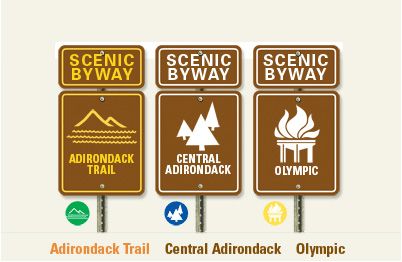
The Adirondack North Country Scenic Byways are three routes that cut through the Adirondack Park and are part of the New York Scenic Byways Program created by the State Legislature in 1992. In fact, if you have driven through the Adirondacks, you probably have been on a byway. The Adirondack Trail, the Olympic Trail, and the Central Adirondack Trail are featured routes that make up the Adirondack North Country Scenic Byways.

Byways are not unique to the region; there are both national and state routes. The National Scenic Byway Program is designed to “help recognize, preserve and enhance selected roads throughout the United States.” The iconic Route 66 spanning the country from Chicago to Los Angeles is an example of a National Scenic Byway. Another is the coastal highway, Route 1 in California.

The Seaway Trail, a 454-mile route following the St. Lawrence River, Lake Ontario, the Niagara River, and Lake Erie, is the only National Scenic Byway in New York State. National Scenic Byways are selected by the United States Department of Transportation’s Federal Highway Administration based on criteria from multiple categories: archeology, culture, history, natural features, recreation, or scenic qualities.

The Adirondack Byway system is different from those of many other areas. While all byways provide a unique traveling experience, unlike other areas where the routes divert visitors from main transportation roads, the Adirondack Byways are the primary routes used by people who live and work here. These roads connect over 200 communities in the Adirondack region while offering paths to the amazing scenic beauty. The byways are designed to link travelers with beautiful, picturesque drives, and also shed light on the rich history and culture of the region while providing resources to appreciate wildlife and outdoor activities.

Interpretive signs, as well as commemorative plaques, can be found along scenic byways educating visitors traveling along the route. When you pass through the Central Adirondack Trail, one of the historic plaques you can look for is located at the site of the great forest fire of 1903, just south of Old Forge, New York on Rt. 28.

There are also interpretive panels located along the Hudson River at North River, N.Y. highlighting the historical impact and importance of the Hudson River in the region.

The Adirondack North Country Scenic Byways offer three routes starting at a point outside of the Adirondack Park traveling through the Park and out to an exterior point. The routes are designed to connect communities along a scenic byway and promote travel in all four seasons.

The Adirondack Trail begins in Malone, New York, ten miles from the Canadian border and travels south through the Adirondack Park. The theme of woods and waters is highlighted along this route, promoting destinations such as the Visitor Interpretive Center at Paul Smiths, the Saint Regis Wilderness Canoe area, and a string of communities that offer beautiful lakeshore views such as Tupper Lake, Long Lake, Blue Mountain Lake, Indian Lake, and Speculator, N.Y. The communities are promoted for their scenic beauty as well as their cultural and historic offerings. The Adirondack Trail continues through Gloversville and Johnstown, ending in Fonda on the Erie Canal.

When traveling this route a destination of interest might be the historical St. John’s in the Wilderness Episcopal Church that was founded in 1876 by Dr. Edward Livingston Trudeau with the assistance of many wealthy camp owners in the area, including legendary guide and hotelier Paul Smith.

The Olympic Trail begins near Lake Champlain in the town of Keeseville, N.Y. and travels across the north-central Adirondack region to Sackets Harbor on Lake Ontario. This route highlights the Ausable River and Lake Placid, known for two Winter Olympics held there. The route continues past a number of beautiful lakes, traveling through the Saranac chain of lakes, Tupper Lake, and Cranberry Lake on its way towards Watertown. The route links with the Seaway Trail near Sackets Harbor, home to a number of historic sites from the War of 1812.

While traveling the Olympic Trail take time to enjoy the High Peaks Wilderness Area. It is the largest wilderness area in the region, spanning six towns and is home to New York State’s highest peak, Mount Marcy.

The Central Adirondack Trail starts in Glens Falls, N.Y. and travels on a horseshoe-shaped path through the south-central Adirondacks. The route follows a theme of history and culture, highlighting colonial heritage, Adirondack Great Camps, the Gilded Age, and the Adirondack Museum. Lake George’s Battlefield Park is located on the Central Adirondack Trail. The battlefield was important in both the French and Indian War (1755-1763) and the American Revolution (1775-1783). The park includes monuments and illustrated signs depicting the important events that occurred at that spot. This route also calls attention to the interconnecting lakes and streams that are seen as a paradise for boaters. The path ends in Rome, N.Y. noted for the important Revolutionary War role of Fort Stanwix.

While each byway promotes its own intrinsic themes, travelers can customize their travels based on specific curiosities. When driving, be sure to keep your eye out for scenic byways signs. Whether traveling through the Adirondacks or elsewhere, rich stories and sceneries abound on these routes.

Lake Placid Winter Olympic Games

Lake Placid has had the privilege of hosting two Winter Olympic games, first in 1932 and again in 1980. While games in the past were much smaller in scale than the extravaganzas they have become, it is still remarkable that a village with a population of well under 3,000 people could host an international sporting event twice.

Both games required the new construction of facilities to host the sporting events. For the 1932 games the additions included an Olympic Stadium and a bobsled run — a sport that many Americans at the time were not familiar with. Over time the games grew in both size and events. The 1980 Olympics required a 90-foot ski jump, a field house for hockey and figure skating, a luge run, a refrigerated speed-skating track, and an Olympic Village.

The first time Lake Placid hosted the games, only seventeen nations were represented by 252 athletes (21 women, 231 men) competing in fourteen events. Thirty-seven nations participated in the 1980 Lake Placid games, and were represented by 1,072 athletes (232 women, 840 men).

Lake Placid was inundated; though only 51,000 people were allowed into the village on any given day, it was still an overwhelming number for this tiny community. (“Money made in ’80 Olympics – without gouging” Press Republican, 2/16/05) The streets became pedestrian malls, and only pre-approved vehicles could drive through town. (Adirondack Life, Jan/Feb 2005)

The thirty-eight events were successful due largely to the work of over 6,700 volunteers who assisted with managing crowds, directing visitors, driving shuttles, and countless other tasks to ensure that the events ran smoothly. Many full-time Adirondack residents filled these roles, receiving special credentials and blue parka uniforms, one of which resides in the Adirondack Museum’s permanent collections.

On February 22, 1980, the Lake Placid games became famous for “The Miracle on Ice.” The United States hockey team, consisting of amateur and collegiate players defeated the Soviet Union’s team, previously considered the best in the world.

Also in 1980, Eric Heiden, a U.S. speed skater, accomplished the unique achievement of winning gold in all five events that he competed in, breaking the previous held Olympic records in each, and becoming the first person to win five gold medals at a single Olympic games.

Lake Placid continues to play a significant role in the Olympic community. Its facilities are still used as training centers for current Olympic contenders. Athletes from around the nation travel to the Adirondacks to train. In addition, a significant number of regional athletes have received national recognition in their sports. Be sure to keep an eye out for our local Olympians next time you watch the winter games!

Balsam Traditions-Balsam Bed

The Balsam Fir tree has been an important natural resource for the Adirondack region for many years. Below are excerpts from a poster series entitled “Balsam Traditions” that illustrate the seasonal uses and importance of balsam.

“The mountain goose is not a bird but a tree. It is humorously called a goose by the woodsmen because they all make their beds in its ‘feathers.’ It is the sapin of the French-Canadians, the cho-kho-tung of the New York Indians, the balsam of the tenderfoot, the Christmas-of the little folk, and that particular Coniferae known by the dry -as-dust botanist as Abies.”

Daniel Carter Beard (founder of the Boy Scouts), Shelters, Shacks, and Shanties, 1914.

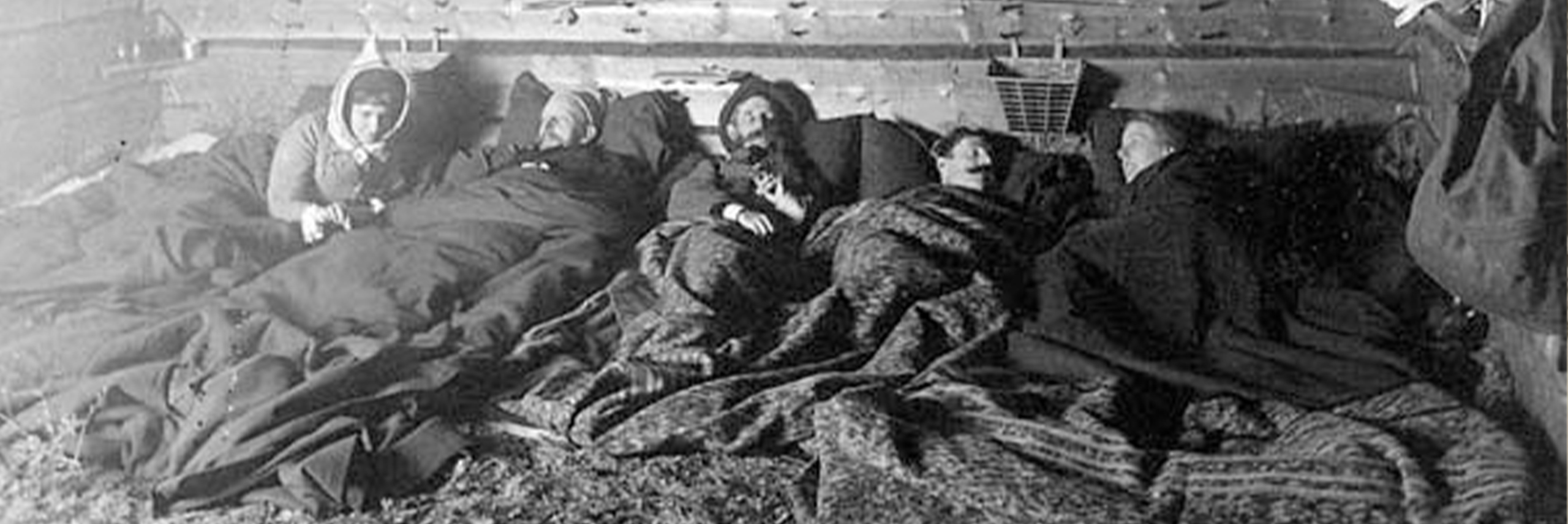
“To all woodsmen the balsam is a friendly tree. Green, it will not burn, and seasoned, it burns too rapidly. But for generations of tired bodies it has furnished a soft and scented bed. “

T. Morris Longstreth, The Adirondacks, 1917.

“You can talk about your waterbeds or any of these fancy mattresses that you get today, but if you haven’t slept on a balsam bough bed, you don’t know what you’ve missed!”

Buster Bird, interviewed by Joan Payne, Adirondack Discovery, 1987.

“First, a base of balsam boughs was laid on the ground. Next, several loads of balsam tips were then stuck upright in the boughs with the bottoms bent under an inch or two. The result was a soft, springy bed fit for tender New Englanders, if not for the delicate lady in the story of the princess and the pea. “

Paul Jamieson, Adirondack Pilgrimage, 1986.

“After a day of such activities in the open, a bed of balsam before a campfire is an insurance against insomnia. It is also a cure for many other ills, both real and imaginary. One can always sleep the sleep of an infant.”

Henry Abbott, The Birch Bark Books of Henry Abbott, 1914-32.

“Balsam had a rich fir fragrance so nice for a pillow. It carried the aroma indoors. Put your head on a balsam pillow, shut your eyes, and feel of the forest went with you to the land o’ dreams.”

Edna A. West Teall, Adirondack Tales: A Girl Grows up in the Adirondacks in the 1880s, 1970.

Information from Balsam Traditions (a poster series) by Todd DeGarmo. Adirondack Museum and Crandall Library, 1992, with support from the New York State Council of the Arts — Folk Arts Program.